Free Market Environmentalism (FME) Fails to Tell the Whole Story

Anderson and Leal (1998) by all rights needed to be a response to the critique by Blumm (1992) of the book by Anderson and Leal (1991) titled and touting Free Market Environmentalism (FME). Through the DIT (Dual Interest Theory) lens, Blumm (1992) made the convincing case that FME leaves out the most intriguing part of the story, by claiming a market in environmental resources dealing only in the domain of the profane also adequately addresses the sacred side of said resources. The economy, after all, is embedded in the Spaceship Earth system, and, within all the institutions humans have created to sustain that sacred system.
So, as a case in point, FME claims that creating water markets in water use rights solves all the challenges of sustaining the most essential --- and in that sense, sacred --- resource on this water planet, on this Spaceship Earth. Somehow --- it is never explained --- a market will sustain the entire hydrologic system to include all the natural storage and transport systems like aquifers, lakes and rivers. FME makes the bold claim, which is justifiably put into question, that the Market Forum can represent all the values, price P money and value O non-money values. So, the only thing the Other Forum(s) in a Democracy charged with representing value O and tempering price P need do is award (to whom we are not told) and define the private property rights --- like water use rights --- and enforce same. Unfortunately, Anderson and Leal (1998) never even mention said point, which is the point of the on-target critique in Blumm (1992).
Also, as it starts out in Anderson and Leal (1998), a strawman is used to frame the defense of FME, as in the only alternative to FME is “centralized planners … to aggregate information about social costs and social benefits (p. 111).” It is the old trope by mainstream economists --- especially the libertarian branch --- that extreme socialism on the way to communism with all public property is just over the horizon if some government agency perhaps lays out a plan to ensure an aquifer is not over pumped, or a river is not drained dry. The only way to avoid all public property in communism is to go to the other extreme, and change all the current public property to private property so that capitalism can prevail.
It is an old story attributed to Hayek (1944), as in even just a bit of public property is a slippery slide that ensures moving to all public property under extreme socialism on the way to communism, as in the Road to Serfdom. It is the old trope, and unfortunately often an effective scare claim to stir fear the FME (and the politicians who also are all in on FME, which gives it the flavor of an ideology not a science) always put into play. And, it never acknowledges the reality that moving too far toward pure capitalism with private property in everything is just another Road to Serfdom.
The fear is always instilled indirectly, even if not saying it directly. Somehow --- without any empirical justification ---- pure capitalism with all private property and no public property is always superior. In such a system, we might suppose, even well-defined private property in such things as the hydrologic system to include the natural storage and conveyance system over the entire Spaceship Earth must be invoked. Spread to all environmental and natural resources, the FME goal is apparently for a few wealthy people to own the entire Spaceship Earth, in that unfettered, nonattenutated (like the Libertarians, Anderson and Leal included, insist is essential) private property only systems inherently move to Scroogism in oligarchic form, a clear Road to Serfdom for everyone else.
As DIT makes clear, that in effect, the FME claim that an unfettered Scroogism is inherently better than even a bit of Socialism is just ideological conjecture, not based in empirical reality. And, while clearly some private property to facilitate a bit of marketing, and, some Scroogism encouraged, it must be tempered by Socialism. DIT clarifies the goal is to strike a reasonable balance in Scroogism & Socialism, private & public property, incentive & ethic, and, writ large, strike balance in the profane & sacred dimensions inherent to every environmental and natural resource. Again, using water as a case in point, as in all water on the water planet we know as Spaceship Earth, it certainly has a nonseparable sacred dimension embedded in any profane use. FME chooses to ignore the sacred, and sees only the profane.
Anderson and Leal (1998) point out: “The purpose of this paper is to counter the traditional way of thinking about natural resource and environmental problems with an approach known as free market environmentalism ("FME"). This alternative recognizes and emphasizes the costs of coordinating human actions. It does not assume that the costs of obtaining information or coordinating activities are zero or that there is perfect competition. To the contrary, FME focuses on how the costs of coordinating human actions (transaction costs as economists have labeled them) limit our ability to attain human goals given our limited resources and technology (p. 112).” Well, let’s see where it goes, in that it is the Other Forum that works at tempering the transaction costs, works to minimize the transaction costs, and thus makes the Market Forum possible.
As DIT makes clear, it is the forming and acting out in the Other Forum to find and evolve the shared other-interest that gives the transaction costs, and works to minimize same. Said Other Forums are about minimizing transaction costs, but it is not the Market that does so. It is the Other Forum that makes the Market Forum possible because of it.
I. TRANSACTION COSTS ARE EVERYWHERE
Anderson and Leal (1998, p. 113) point out that: “In contrast to the market failure emphasized by Pigou, Nobel laureate Ronald Coase opened the eyes of policy analysts to the importance of transaction costs.” Yes, that is true. Anderson and Leal (1998) the point to the nonexistent theorem, as in the “Coase Theorem” --- which was about a world of zero transaction costs, with Market always achieving efficiency in said world.
Well, yes, but as Coase would say it, “There are always transaction costs,” so one does not need a Theorem about a magical world that has zero transaction costs, something that does not exist in reality. But, then, FME brings magic in regularly, so, why not a nonexistent Theorem, too. It was imagined (sort of like the invisible hand, a convenient claim to deny any role for Government other than enforcing private property rights) by people who would support FME.
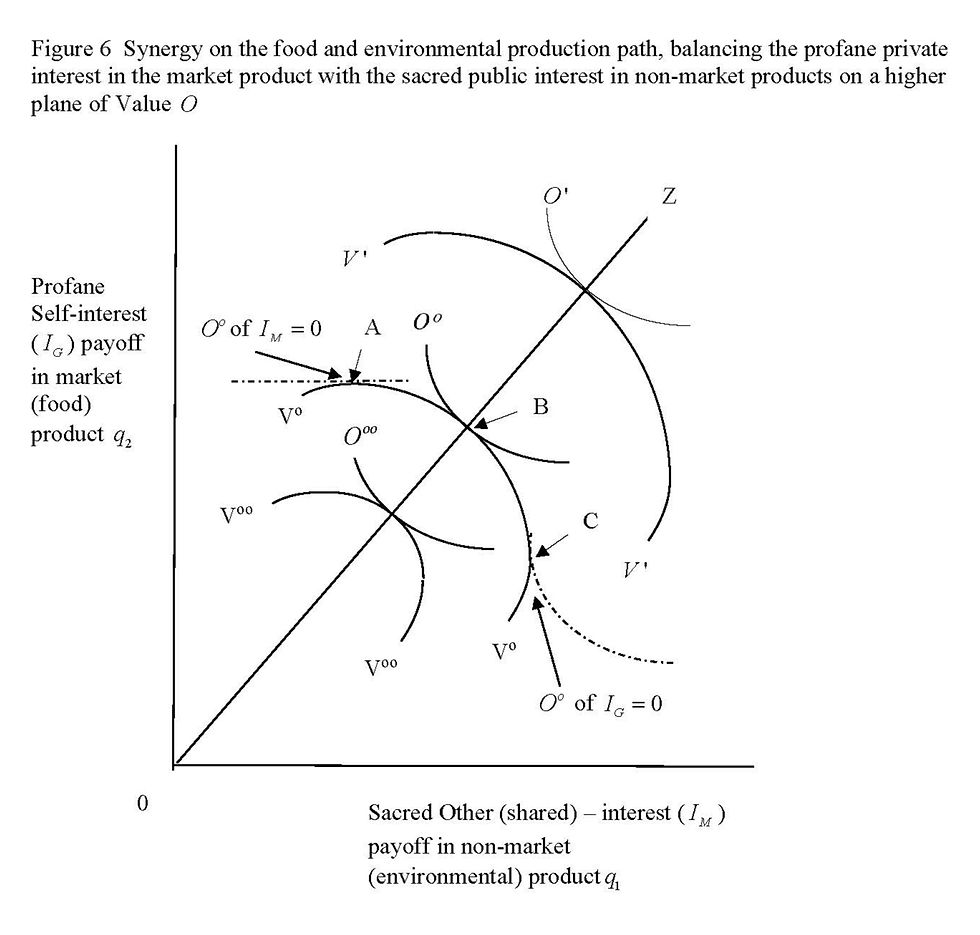
As Anderson and Leal (1998, p. 113) frame it: “The important point of the Coase theorem, as it has become known, is that transaction costs explain why individuals bargaining for gains from trade may not always attain the expected or desired results. If transaction costs, including the costs of being well-informed and of bargaining were zero, market failure as described by Pigou would be a non-problem (p. 113).” Yes, but the reality is that failure in the Market Forum represented in Figure 5 is pervasive unless an Other Forum represented in Figure 6 is operating in the background to minimize the transaction costs. Because “Coase Theorem” framing sees only self-interest on some path 0G, it fails to see the transaction costs arising from forming and acting on the shared other-interest path 0M. Economic efficiency cannot be achieved, as in finding path 0Z, without paying the transaction costs coming out of the need to acknowledge path 0M.

A. INFORMATION COSTS
So, FME claims the only way to get adequate information, e.g., information adequate sustaining and allocating the water from an aquifer, like the Floridan Aquifer underlying the entire State of Florida, is with private property water use rights. The problem of said owners of water use rights having adequate knowledge of the hydrologic engineering information about the characteristics of the underlying aquifer is ignored, or, we might suppose, coming from the zero transaction costs, invisible hand of the Market. Just how would thousands of individual water use right holders decide how much to draw from the Floridan aquifer such that the springs do not stop flowing, which would eliminate the habit for many creatures like the especially visible Florida manatees. Also, not only the manatees, but how would the Market ensure that pumper A is not going to greatly harm pumper B down the road?
The empty claim that the Market Forum will have all the relevant information from merely assigning water use rights to pumpers lacks in any sense of reality. The need for something like a Florida Water Management District --- an Other Forum --- that employs hundreds of hydrologists, engineers, and economists is clear, and costs to fund and operate such Districts part of the transaction costs that must be considered in developing Market Forum to exchange water use rights. Also, the empty claim that only the Market can reveal true value, as though the profane price P of a water use right is the only relevant value is simply lacking in credibility. Water also has a sacred value O of such things as spring flows to ensure habitat for the Florida manatee, and that sacred value O can only come out of an Other Forum.
Also, Anderson and Leal (1998) see the Other Forum only in the larger frame of voting in elections, quite oblivious of the monthly meetings of Other Forums represented in entities like the Florida Water Management Districts, as in : “In the political arena, we communicate our values by voting, protesting, letter-writing, and contributing to campaigns, and politicians decide whether they want or can meet the competing demands for goods and services subject to political constraints (p. 114).” Well, that is part of it, but so much else is going on in the realm of environmental management, with several layers of local, state and federal agencies. Point is: The huge middle ground between the FME styled Market Forum where anything goes and central planning by a government agency --- the only two forums Anderson and Leal see --- is where the American Democracy based Other Forums operate.
It is in said Other Forums the shared other-interest in the water resource (all environmental resources) are brought into full view. The Anderson and Leal (1998) claims are being framed by SIT, and the individuals buying and selling water use rights only to serve self-interest will somehow also serve the shared other-interest, as though by magic.
B. CONTRACTING COSTS
Anderson and Leal (1998, p. 114) also point to trades in such things as water use rights can have high transaction costs, as in “… contracting costs make it more difficult for consumers and suppliers-whether in markets or politics-to coordinate with each other for the purpose of enjoying gains from trade (p. 114).” As DIT makes clear, said transaction costs are brought to a minimum in well-functioning Other Forums, again, in something like a Florida Water Management District. It is about Market & Government in a joint effort to keep transaction costs to a minimum, something the Market cannot do by itself.
C. THIRD-PARTY COSTS AND BENEFITS
The flawed character of SIT one again comes into full view in the FME claim: “…pollution is the classic case of a negative externality wherein costs are imposed on others without their consent." A classic case of a positive externality is the enjoyment of an environmental amenity, such as a scenic view. It is difficult to exclude viewers who do not pay (p. 114).” As DIT makes clear, there is no such thing as an externality when the shared other-interest is in full view, handled within the Other Forum.
It is an externality only because the SIT frame on how systems are to be constructed leaves out the essential role of entities like a Florida Water Management District to ensure the trade in a water use right between a willing buyer and seller does not harm others, or harm the environment. In DIT framing, externalities vanish, because said things did not exist in the first place when a viable Other Forum is operating to bring the value O (as in Figure 6) into view to influence the actual trade (as in Figure 5).
D. TRANSACTION COSTS IN MARKETS AND POLITICS
Anderson and Leal (1998) go on to explain how the Market vs Government obtain information, and consider it. Notice the “vs” as though in a kind of competition, when instead acquiring and bringing information into play, value information and otherwise, as DIT clarifies must be a joint effort involving Market & Government, self & shared with the other-interest. Following along: “In a world of scarce resources, private managers or political resource managers must obtain information about the relative values of alternative uses of these resources … In well-developed markets, prices provide an objective measure of subjective values and are therefore an inexpensive source of such information (p. 115).” Perhaps.
The problem is, not everyone is involved in influencing that price P in the domain of the profane --- not everyone owns water use rights, and not everyone has the same wealth to express value via price P --- so it is only the buyer and the seller finding the Market Forum clearing price P. So, the value O in the domain of the sacred is not necessarily represented at all. As already alluded to, the Other Forum must also be influencing the outcome, like in setting a cap on how much of the water coming out of a source can indeed be put into the Market. And, there is nothing objective about price P other than it is an expression of subjective value that has been monetized.
Anderson and Leal (1998, p. 116) continue: “In the public sector, on the other hand, there are few markets for these amenities and no profits to motivate decisions. Recreational users of public land generally pay little or nothing for the services they receive. … The existence of prices in the marketplace, and their absence in the political arena, lowers information costs in the former relative to the latter.” Well, such information costs are legitimate kinds of transaction costs, and with an effective Other Forum also operating, such information costs play a legitimate role in working to influence the price P coming out of the Market Forum. Just ignoring the value O coming from other sources does not justify claiming the lower information costs from ignoring value O is somehow justified in claiming, as in FME, the Market is always a superior forum operating, even when without any real regard for the key role of the Other Forum.
The turn is then to contracting, working to make the case the Market is better at it, with lower contracting costs. The problem with the claim is that a Market ignoring the shared other-interest of the citizenry in the trade between buyer and seller, and thus having lower contracting costs than an Other Forum trying to weigh the shared interests of all citizens, does not make it inherently superior. One of the results is: “Political outcomes do not always reflect citizens' desires; the political process may, therefore, supply too many goods such as nuclear arms or too few goods such as quality education (p. 116).” Well, Market outcomes also do not always reflect citizens’ desires.
The missed point here is that the shared other-interest is always in the background, and the extent to which it is represented is the key, as in the key role of the ethic of the transaction in the Market Forum and the Other Forum is the key. Anderson and Leal (1998) put all attention to the incentive, and give no attention to the ethic, the latter reflecting the shared other-interest in the outcome. And, while the Market Forum operating in the domain of the profane plays a key role in allocating resources, the Other Forum must also be involved in order to assure the sacred (represented in the shared with the other interest) also gets due attention.
The problem of special interest groups acting out on self-interest is also considered, as in the problem of concentrated benefits and diffused costs. It is a problem, and, again, it can only be fixed with due attention to the shared other-interest with the people paying the costs. Perhaps the concentrated payoff to the special interests fits with the ethic shared with the other. Perhaps not. It is an empirical question, and the Other Forum must work to ensure it is addressed and answered. Seeing only self-interest at play, as is the modus operandi of Anderson and Leal (1998), does not solve the problem.
Anderson and Leal (1998) then point out that the Other Forums of Government also sometimes do not pay adequate attention to the widely shared other-interest, e.g., in pollution coming out of military bases. Also, dams built by Federal Agencies can affect fish movement: Well, true, but there was an Other Forum that made that decision, generally at least using benefit-cost analysis, and in later years, using multiple objective analysis (which could have benefited greatly from using DIT, and, in fact, was an inspiration for what came be DIT) was also sometimes done. So, good points, but pointing it out also does not justify paying little enough attention to the shared other-interest as is the way of the Market Forum.
Anderson and Leal (1998, p. 118) continue: “The nature of government funding generates another type of third-party effect. Governmental programs, ranging from wilderness and parkland maintenance to the cleanup of toxic waste sites, tend to concentrate the benefits of such programs for special interest groups and diffuse the costs over a large segment of the population.” Well, yes, the Other Forum can make mistakes. Special interests can make way into said Other Forum and take advantage. It is also true, however, that special interests can amass large amounts of wealth and buy water rights in markets. It is not clear the market does a better job of dealing with the concentrated benefits and diffused cost problem.
Another intriguing contention: “And just as externalities result in too much pollution or in overgrazing of the commons, political externalities result in excessive production of public goods (p. 118).” Well, perhaps: The issue here is the manner in which the shared other interest has been brought into play. If a market forum does not consider the shared with the other interest, then the effect on others could be rather dramatic. An Other Forum, if it is well orchestrated, would clearly address the shared other interest. It is that shared other interest that is --- at least it is supposed to be --- the focus of the Other Forums of Government.
And, then on behavior:
“Once incentive effects are recognized, we can no longer rely on good intentions to generate good natural resource and environmental management. Even if the superintendent of a national park believes that grizzly bear habitat is more valuable than additional campsites, his good intentions will not necessarily result in the creation of more grizzly bear habitat. In a political setting, where camping or snowmobile interests have more influence over a bureaucrat's budget, his peace and quiet, or his future promotions, intentions will have to override incentives for grizzly bear habitat to prevail .… On the other hand, if a private resource owner believes that grizzly bear habitat is more valuable and that he can capture that value through a market transaction, then politics will not matter. If those demanding the preservation of grizzly bear habitat are willing to pay more than those demanding campsites are, then incentives and information reinforce each other … alternative management institutions simply cannot be adequately analyzed without careful attention to information costs, contracting costs, third-party costs, and the incentives faced by the actors involved. Under this lens, the public sector ---with all of the trappings of public interest --- faces the same scrutiny as the private sector (p. 119).”
Said analysis is using SIT, which rests in the presumption lacking in empirical evidence that the only driver of human behavior is self-interest. It presumes without empirical evidence that not only everyone in the Market, but also everyone in positions within the Government are self-interest only, oriented. Also, it leaves out the fact that the Other Forum of decent, ethical Government employees and hopefully the election Government officials are actually representing the shared other- interest.
What is left out, as DIT makes clear, is the fact that humans are driven to strike balance in the self & other interest, especially expected of the Other Forum. So, it is not just about the price P people are willing to pay for campsites, or some other group is willing to pay for ensuring grizzly bear habitat, but the shared other-interest in striking a balance to ensure both are supplied. That balancing of multiple objectives as influenced by such things as the sacred value O of grizzly bears being sustained in resolved in Other Forums. The Other Forum deals with such value O considerations; the Market Forum does not, as it sees only price P.
II. SCIENTIFIC MANAGEMENT OR ECONOMICS WITHOUT PRICES
Anderson and Leal (1998, p. 119) start the story here with the frame: “The idea of scientific management surfaced in the United States with the formation of the U. S. Forest Service in the late nineteenth century. Ostensibly, scientific management directed at the federal level was supposed to be the answer to the perceived exploitation of U.S. forests.” The claim is that the Service eventually had to move away from just producing timber to balancing multiple objectives to recognize, in DIT terms, a multiplicity of value O considerations beyond the price P of timber. And, that it failed, because the Market could have done much better.
Anderson and Leal (1998) proceed with an assault on scientific management, which can never (it is claimed) have the correct value information, which is only price P as FME claims without justification. It is claimed, again without empirical foundation, that in effect scientific managers operate only on self-interest, as in a Market, but that the managers can never have accurate price P information that would evolve in a Market with many buyers and sellers. Well, yes, but forest managers are also working to serve the shared other-interest that is often best expressed as a non-money value O in the domain of the sacred, and not just price P in the domain of the profane.
As Anderson and Leal (1998, p. ) characterize it:
“The idea of scientific management ignores the incentives of both consumers and suppliers in the political sector and can therefore mis-guide public policy… A system of private water allocation, for example, will not provide a sufficient supply of instream flows for wildlife habitat and environmental quality if owners of water cannot easily charge recreationists and environmentalists who value free-flowing water. In addition, too much pollution will exist if firms do not have to pay the full cost of waste disposal. Hence, they ‘overuse’ the air or water as a garbage dump. Such under- or overproduction is often taken as a sufficient condition for political control of resource allocation.”
Anderson and Leal (1998) find it insufficient. Rather, it is a matter of putting an absolute, nonattenutated environmental use right … like in the case of water, a right covering all the water in the aquifer, and all the water in the river, in the hands of a few water use right owners and working out all the value questions in a Market which deals only in price P. The point that is missed: An intermediate Other Forum is needed, one that draws on scientific realities, and gives context to more limited water use right market, one that has a cap defined by value O, on how much can be allocated in the price P arena.
Rent-seeking is the frame used to justify the claim. Again, because SIT is used, the only reason anyone goes into an Other Forum is to take the resource before someone else gets it, or take it away from someone who already has it in use. Rent-seeking becomes something quite different when one sees it through a DIT lens, as in people seeking the rent are tempered by the shared other-interest in providing for other objectives. Rent-seeking through obtaining water use rights, e.g., are tempered by setting caps on how much can be taken from the river, the caps reflecting the value of instream flows decided in an Other Forum.
Instead of seeing that the Other Forum pay attention to the share other-interest, Anderson and Leal (1998) claim: “Because politicians and bureaucrats are rewarded for responding to political pressure groups, there is no guarantee that the values of unorganized interests will be taken into account even if they constitute a majority of the population.” Well, that would be a failure in the Other Forum, as all interests are to be represented as composing the shared other-interest, but, then, a Market Forum would also do the same thing, especially given that water use rights like in the Western States were basically established through violence and the use of guns in the first place, and other groups clearly were not represented in the initial allocations, so the question is how does trading in said rights fix the problem.
The title of the section should be: "Market Management Without Non-Money Value O," or, simply, "Market Management Without the Sacred Poetry." It is presumptive to claim the Market can represent all value, in that it can only reflect the expression of price P for things that can be quantified, like pushpins in the domain of the profane. Also, that expression of value comes only from people having the money to be in the Market. Non-money valued goods with value O in the domain of the sacred are given short shrift, and need the Other Forum operating to give context to the search for price P in the Market.
Anderson and Leal (1998) point to the notion of marginal value, and how a Market Forum would just naturally move resources to the higher marginal values, measured exclusively in monetized price P terms, making for efficiency, clearly seeing only path 0G in Figure 5. It is claimed an Other Forum using marginal analysis would fail in accomplishing said outcomes, not ever mentioning that the Other Forum must bring value O into play, and if it is not, as DIT makes clear, true efficiency can never be achieved on path 0Z. But, that is never mentioned, but, instead, another nuance is given attention in the claim that thinking in terms of marginal values in the Other Forum “…that such logic and simplification are not helpful guides because they mask transaction costs and incentives.”
The claim is that the incentives of the resource manager are all about the self-interest of the manager, and the manager cannot know the marginal values. Anderson and Leal quote Hayek (1944), who was concerned about an extreme socialism with central planners. And, sure, central planners not operating in democracy based Other Forums within which a great deal of talk, talk, talk is made possible by all the ordinary people affected by the resource allocation could make dramatic mistakes, especially about price P. But, a Market Forum could also make dramatic mistakes, especially about value O.
And, then, on transaction costs, Anderson and Leal (1998) fail to recognize that transaction costs arise in the operation of the Other Forum. And, in fact the transaction costs are minimized by the Other Forum., and cannot generally be resolved just in a Market Forum. Quoting Hayek (1944) once again, the real challenge is ‘it is a problem of utilizing knowledge not given to anyone in its totality’ (Anderson and Leal 1998, p. 1998), and while an well-orchestrated, inclusive and democracy based Other Forum facilitates brings in value O information, and the Market Forum brings in price P information, neither one can do the full job alone. Hayek (1944) fully understood the Government (the Other Forum as DIT frames it) needed to play a key role in the economy, a point missed in the Anderson and Leal (1998) incentives and transaction costs analysis story which frames Government as a cadre of central planners to be avoided at all costs.
Anderson and Leal (1998) continue throughout to section to quote Hayek (1944), who was critiquing extreme socialism on the way to communism with all public property and central planners setting prices. It is a favorite way of the Libertarian and Neoliberal Economists going back to the Mont Peleron Society formed in 1948, and, carried forward by key figures like Libertarian Economist Milton Friedman well into the 1970s, to distort the key role played by an inclusive Democracy based Other Forum representing ordinary people.
Anderson and Leal (1998, p. 123) do give a bit of space to Institutional Economist Daniel Bromley whose claims fit nicely within the frame of DIT (which draws heavily on both Institutional and Behavioral Economics), as in this quote from Bromley, how the Government is:
“…politically responsible to the citizenry through the system of ... elections and ministerial direction. However imperfect this may work, the presumption must be that the wishes of the full citizenry are more properly catered to than would be the case if all environmental protection were left to the ability to pay by a few members of society given to philanthropy… claims for volitional exchange are supported by an appeal to a body of economic theory that is not made explicit,"
Well, Bromley is referring to some Other Forum in Government bringing the shared with the other-interest in view, and not exclusively relying on some magical volitional exchange in a Market Forum, which is running under the presumptions of SIT and that fact is not being made explicit. That is, to FME framing, as Bromley is framing it, the claim that only the self-interest of the private property owners in the profane dimension of the environmental resources is to count, and, in effect all that is sacred is left to philanthropy. The shared other-interest in the outcomes of assigning said rights to a group of owners is of no accord. And, then forever there after leaving the value decisions to buyers and sellers of said rights is not thought to have any adverse outcomes.
More fallacious claims are revealed as the logic is carried forward, as in “Efficiency is not the direct goal of private sector decisionmakers either, but because profits result from decisions that move resources from lower valued to higher valued alternatives, there is a tendency toward efficiency in the private sector (p. 124). Well, yes, the private sector economic efficiency goals in the domain monetized price P, the domain of the profane, is on path 0G. In contrast, the social efficiency goals in the public sector are better described on path 0M. And, as DIT makes clear, true economic and social efficiency can only be achieved on path 0Z, with the Other Forum influencing the outcomes in the Market Forum, something that Hayek (1944) fully understood, such that referring to Hayek as some total defender of FME distorts the Hayek framing.
Section is closed out by quoting an Anthony Fisher. Who points to how? Bold markets and planners could well fail. As DIT makes clear, that is absolutely the situation. What is needed is a joint market & other-forum operating in consort. Intriguingly, the final claim is: “Without information and incentives, scientific management becomes economics without prices.” The information and incentives are described by SIT, in a situation of unattenuated private property and consideration of value as only price P. DIT makes possible the same kind of claim: Without information and incentives coming out of the Other Forum, market based management becomes politics without value.
III. GETTING THE INCENTIVES RIGHT
The discussion of incentives presumes SIT accurately describes all humans, as in every consumer, producer, government employee and politician is focused exclusively on self-interest. DIT refers to said kind of human as an Econ. And, sure a few people are dominantly of said nature, operating on path 0G, and the closer to the vertical axis the better. It is ego-based self-interest focused on the profane in full view. Unfortunately, the view of the human as an Econ stands on shaky empirical ground. DIT which is based in the latest neuroscience and behavioral economics, and in the older institutional economics tracing back to Veblen and Commons, sees Humans who strike balance in the ego-based self & empathy-based other. So, “getting the incentives right” means something completely different when seeing only the Econ in contrast to the Human.
Seeing only the Econ shows here:
“if the costs of excluding fishermen from a free-flowing stream are high, then there will be less incentive for the private landowners to provide fishing streams; market failure is said to result in the underproduction of such public goods. The government's coercive power to charge all citizens (or at least all fishermen) can overcome this problem. Unfortunately, this coercive solution creates another problem; namely that citizens cannot be certain that the state is producing the desired bundle of public goods. Indeed, the fundamental dilemma of political economy is that once the state has the coercive power to do what voluntary (market) action cannot do, how does it prevent that power from being usurped by special interests?”
Well, coercive special interests also arrive in the garb of people with a lot of wealth. Spending it in the way said people want to spend it is coercive for other people who cannot afford to participate in that allocation process. So, people without adequate money who value a free-flowing river on the grounds of it being sacred, as in habitat for a wild species of fish, could be coerced into not having that river if the water use right holders can sell that river to whoever they wish. And, on citizens not sure the state is producing the desired bundle of public goods, said public goods clearly are not in view when a SIT framed market focused exclusively on individual good is in play. Public goods get no play at all in an individual good only Market.
Also the implication is that FME will somehow do a better job in addressing the measurement problem, as though everything has to be measured, even in the domain of the sacred: “Public goods such as environmental quality, risk management, soil conservation, national heritage, and wilderness values are all costly to measure (p. 126).” Yes. But, it is not clear that 1) a Market Forum can measure such goods any better than an Other Forum, and 2) that said goods even should be measured, as in some things just cannot be reduced to a number, and, even more difficult, a price P. It is also claimed that monitoring the efforts of the Other Forum to deal with such matters is more costly than would be experienced in a Market Forum.
It is then claimed “… measurement costs are greatly reduced in market transactions by prices… Because many governmental goods and services are not priced, transaction costs are higher in the political sector … Prices also allow a measure of efficiency through profits and losses… output of government is not priced and where agency performance is not measured by the bottom line, profits and losses in the private sector provide concise information with which owners can measure the performance of their agents.” Well, some things should not even be measured in price P terms, and thus operating only on a pseudo-efficient path 0G trajectory. Many environmental resources are sacred with only value O, and transaction costs must be paid to ensure the sacred on some path 0M. The whole point is that transaction costs are valid in the domain of the sacred, wanting to avoid same does not justify turning everything into a monetized, price P resource. The performance measure of the Other Forum is if adequate attention is paid to the sacred on path 0M.
Anderson and Leal (1998) then turn to how poorly informed voters might vote to bring some public good into play that does not serve the public good. The claim is that it behooves the buyer and the seller to be well-informed, such that the resources move to the highest value use. Well, that serves individual good, but it clearly is at best weakly linked to public good. A well informed seller of water use rights for industrial development near a free flowing river, the buyer as that industrial user, will become well informed on what the water is worth in price P terms in industrial development, but the value O of the free flowing river does not count. So, the claim that a Market Forum is well informed and an Other Forum is not, well, the question is, informed about what.
A peculiar example of the supplier not being responsive is then introduced. Like a consumer can go to a different grocery store if another one is not supplying what is wanted. Well, fine, but environmental resource are things like the hydrological cycle on the Spaceship Earth, and the only supplier is, well, some would claim God. It seems a trivial example to claime that having private property rights in environmental resources, especially the sacred resources, somehow fix the alternative supplier problem.
Anderson and Leal (1998) do acknowledge that not everything can be turned in private property rights, as in: “FME requires well-specified rights to take actions with respect to specific resources. If such rights cannot be measured, monitored, and marketed, then there is little possibility for exchange (p. 129).” So, we might suppose the very hydrologic system might have to remain a common property, although anything that can be quantified and turned into well-specified private property must be done, according to FME. And, everything that is sacred --- like sustaining an aquifer or the flow in a river --- is left out of the analysis, as only the profane is to count. Government has only one role: Defining and enforcing private property rights.
IV. ADDRESSING THE CRITICS
Again, to keep it all in perspective, addressing the critics is to address the critics of SIT based FME which focuses only on the profane. FME also acknowledges a role only for private property without any regard for public property. FME also in effect denies any role of an inclusive Democracy in which everyone can participate. It must be replaced by a Market populated only by people with adequate wealth to participate in that kind of Forum. So, here we go.
A. WHICH VALUES, ECONOMIC OR ENVIRONMENTAL?
DIT highlights the old profane pushpins and sacred poetry problem that has plagued economic philosophy for all time. FME just simply ignores it, and puts all attention to the profane pushpins. Anything that can be quantified is to be monetized, and anything that cannot be quantified is to be ignored. FME puts all attention to the profane incentive, and ignores the key role of the sacred ethic.
As Anderson and Leal (1998, p. 131) state it, without any concern or the perverse ethic at play: “FME argues that the willingness of developers to outbid environmentalists reveals which values are higher. This is not to say that moral values have no place in decisions or that moral suasion is not a valuable tool for influencing human behavior…. Turning moral values into political issues and arguing that it is a matter of treading more lightly on the earth, however, becomes another form of rent-seeking wherein people with one set of moral values get what they want at the expense of other (p. 131).
Yes, when one sees only a SIT world of Econs, focused exclusively on the individual good without regard for the common good, the claim is accurate. But, it is not reality, as DIT makes clear, in that a developer building something that is embedded within a Spaceship Earth system that is no longer going to be sustained is not economically and socially efficient. Builders seeing only path 0G, and often that path is near the vertical axis, leads to massive inefficiency.
Also, Anderson and Leal (1998) just brush over who has the wealth to buy the environmental resource for development purposes. People seeing the need to sustain the Spaceship Earth may not have the wealth to buy the rights to do so. Such a private property only system does not in any sense guarantee a sustained Spaceship Earth system, as demonstrated over and over. Empirical reality, please.
B. WHOSE RIGHTS?
The distribution of wealth and who can actually express values in Markets is claimed an unimportant matter in FME. The claim is that even if one increased the income of the poor said people would probably buy video games rather than go to a national park to enjoy the grandeur of it all, anyway, so why have national parks provided as a public good all can use. And, then, it is claimed the environmentalists likely have more wealth than the non-environmentalists, so certainly said environmentalists can pay more to buy services of natural systems from private owners supplying same. So, it is claimed the wealth and income distribution has little if any bearing the question of the best balance in private & public property in environmental resources.
Said FME reasoning fails on two distinct fronts: 1) it sees only SIT based Econs, denying Humans are better described by DIT, and have a shared interest in an shared effort to “save magnificent landscapes and species” rather than pay a private owner to do so, 2) total disregard for the sacred, as in the sacred landscape and species diversity is now strictly a matter for the profane, something to be monetized and made subject to profit-seeking. FME in effect denies that anything is priceless, having only a value O represented in an inclusive, democracy styled Other Forum, and as a result cannot be adequately valued in a Market that sees only price P, and 3) moving an environmental resource into a private property itself greatly affects the distribution the wealth, as the now private supplier is the owner of what was coming from the public supplier, the public wealth now transferred to private owner.
As DIT makes clear, the real task is to strike balance in private & public property, wealth & sentiment, incentive & ethic, and, overall, in the profane & sacred. None of said elements are separable into convenient accounts, which is required if only the FME Market Forum is to be used.
C. IS THE CHOICE ONLY BETWEEN MARKETS AND POLITICS?
DIT makes clear the choice is not only between Markets and Politics, as in a kind of competition in Markets vs Government, Market Forum vs Other Forum. Rather, the real task is to replace the notion of “vs” with “&” as in the task is to do the balancing in a joint effort in Market & Community: Government. The “:” here is key, as it signifies an inclusive, democracy based --- We (All) the People Government, bringing all value O considerations into the environmental question to influence the price P associated with said resources.
Fortunately, Anderson and Leal (1998) at least acknowledge the “…growing recognition that between markets and government are community organizations that can play a role in resource allocation. These might be communities of fishermen who regulate access to a fishery or tribal members who restrict access to a grazing common. ” The Ostrom design principles for such communities were already in view by 1998, as in Ostrom (1990).
The problem is: SIT based FME has no placeholder for such communities of shared with the other-interest, which are evolved through such efforts as outlined in the Ostrom design principles. DIT does. And, as a result, DIT sees the clear role of such communities in the notion of the sacred Other Forum of Figure 6 influencing some use, but limited, of the profane Market Forum in resolving environmental access and allocation as depicted in Figure 5.
CONCLUSION
Using DIT helps clarify how to think about the Anderson and Leal (1998) conclusion. The conclusion that FME is superior is framed by a quote from work by Sagoff, which made the point that it is not appropriate to compare a perfect Market Forum based in SIT to an imperfect Other Forum operating in the real world. Said Other Forums can and do make mistakes because it is operating in a real world that is better described by DIT: Humans have dual interests, and balancing the profane & sacred interests as the Other Forums must do is messy. The FME Market Forum is operating in the non-real world of Econs.
The defense of the Market Forum is framed as: “FME explicitly recognizes that this problem arises because it is costly to define, enforce and trade rights in both the private and political sectors.” As DIT makes clear, that is the very point: Said costs are the transaction costs arising out of forming and acting out on the shared with the other-interest in outcomes from the environmental matter in issue. Said costs must be worked out in that Other Forum of Figure 6 before any Market Forum of Figure 5 can work to achieve true economic and social efficiency on path 0Z. The FME frame is simply “define, enforce and trade” and everything will be just fine, which means in DIT terms, the Spaceship Earth is to serve only the profane, and the sacred is of no accord.
It is the old profane pushpins and sacred poetry problem from economic philosophy resolved by the FME frame as ignore the poetry and go with the profane, as though separable accounts with each not influencing the other. DIT sees pushpins & poetry as joint and nonseparable, requiring a joint effort by the Market Forum & Other Forum. SIT used in FME leaves the Other Forum out of view, and, thus, solves a problem that does not have content in reality.
REFERENCES
Anderson, Terry L. and Leal, Donald R. Free-Market Environmentalism. San Francisco: Pacific Research Institute for Public Policy, 1991.
Anderson, Terry L and Leal, Donald R. "Free Market Environmentalism:
Hindsight and Foresight." Cornell Journal of Law and Policy 8, 1 (1998): 111–134.
Blumm, Michael C. "The Fallacies of Free Market Environmentalism." Harvard Journal of Law and Public Policy 15 (1992): 371–89.
Hayek, F. A. The Road to Serfdom. Edited by Bruce Caldwell. Chicago: The University of Chicago Press, 2007, 1944.


Comments