(Brief) Shift in the Chilean Water Code: Re-balancing the Profane&Sacred, 1981-2022

Preface: This brief review distills a more Detailed review of the Celume et al. (2026) paper (see (Details) Shift in the Chilean Water Code: Re-balancing the Profane&Sacred, 1981-2022 ) prepared as part of my work on a book tentatively titled Water Economy: Balancing the Profane&Sacred. The exercise also speaks to the present, ongoing assault on American public property in environmental and natural resources, of the kind the current Administration is pursuing under the banner of Free Market Environmentalism (Anderson and Leal, 1991/2015) — opening sacred lands like the Arctic Wildlife Refuge to drilling, curtailing staff at the Forest Service and Park Service, and generally pressing to move everything into the domain of the monetized profane. Chile’s 44-year experience with a fully privatized water market offers a cautionary, and ultimately corrective, case study in what happens when a resource is left almost entirely on the profane path — and in what it takes to bring it back into balance.
AI-use statement: Following the practice of the authors under review — who state that generative AI was used only to improve clarity and fluency of the essay, under complete human oversight, with no delegation of analysis or interpretation — I likewise used AI, Claude Sonnet 5 --- only to help tighten and shorten this review, not to analyze or interpret the Celume et al. paper.
Drawing on Bauer (2004), and casting it in Dual Interest Theory (DIT) terms, the 1981 Chilean Water Code put almost exclusive emphasis on the profane: Water was privatized, with allocation and reallocation left to a Water Forum, represented by path 0G in Figure 5.

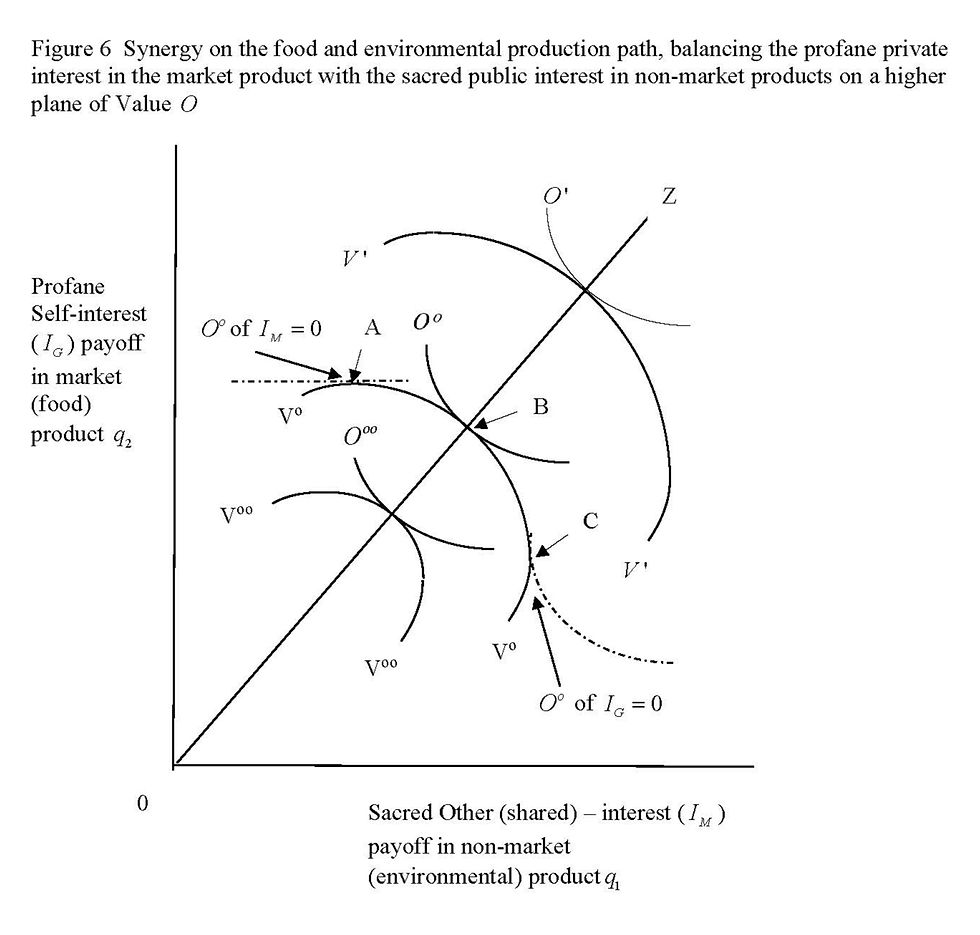
The sacred path 0M was effectively ignored — the 1981 Code built a water economy with no institutionalized channel for influence from the Other Forum represented in Figure 6.
I
Irrigation and hydropower use, both priced at P, came to dominate as Chileans were in effect forced by Market Fundamentalism imposed by the military junta — as self-interest only pursued exclusively on path 0G. After the return to democracy in 1990, Chileans began working to modify that model. Celume et al. (2026) synthesize 63 studies from 1990–2022 to show that the substantive 2022 reform pushed the system toward the sacred, path 0M in Figures 5 and 6, and toward better balance on path 0Z. Among other things, the 2022 legislation — which amounts to a more attenuated private property right — gives greater weight to equitable access, water security, indigenous rights, basic subsistence, environmental sustainability, and ecological flows.
In DIT terms, the shift is away from path 0G — the individual good, measured in market price P — toward more attention to path 0M, the common good, which is not well captured in price and instead is represented by non-money value O arising from Other Forums. Where the 1981 Code built a Water Forum to reveal price P, the 2022 reform works to bring value O, generated in Other Forums, into the same system. It is, in short, an effort to rebalance price P and value O — the profane and the sacred — toward the sacred. The details follow.
The Questions, and the Method
Celume et al. (2026, p. 395) organize their review around three questions: what issues the 2022 reform addresses that the 1981 Code (CA81) left unregulated; how the new framework rebalances water security, environmental protection, and equitable access against markets and private rights; and what challenges persist. Ultimately they ask whether the reform is a fundamental transformation or an incremental adjustment. In DIT terms, the underlying question is how far Chile has moved from path 0G toward path 0Z.
To answer it, the authors conducted a systematic literature search, screening out studies that discussed scarcity or conflict without tying it to specific Code provisions, and retaining only work that linked outcomes causally to the Code itself. The result was 63 qualifying studies (1990–2022), coded by substantive focus, governance mechanism, and recurring linguistic markers. Eight thematic clusters of concern emerged: neoliberal, market-driven regime design; weak and fragmented governance; weak human-rights protection; sectoral and territorial conflict; missing environmental and ecosystem safeguards; judicialization from poor information and expertise; hoarding and non-use of rights; and climate-driven maladaptation (p. 396). Through the DIT lens, every one of these concerns is a symptom of a system confined to path 0G.
What the 1981 Code Got Wrong
The 1981 Code moved Chile from a more interventionist, path-0M-oriented system to one built on private, perpetual rights and free exchange (p. 397). Because large landowners and privatized electric utilities were best positioned to acquire water rights, privatization tended to reinforce existing power structures rather than move water to its highest-valued use. As the literature concludes, “neoliberal water markets are increasingly viewed as a contested model rather than a settled success” (p. 398) — precisely what DIT would predict of a Water Forum operating too close to the profane axis of Figure 5, with no institutional counterweight from the sacred.
That counterweight was largely absent because the 1981 Code hollowed out the Other Forum, leaving the Market Forum to operate without institutional context: transfer and registration procedures were “slow, costly, and difficult to navigate,” reinforcing existing inequalities and leaving the system unable to respond to climate-driven scarcity (p. 399). The agencies that remained were fragmented, under-resourced, and left large gaps in groundwater and aquifer protection, with little room for local or river-basin participation (p. 399). DIT, drawing on Ostrom’s IAD framework, would call for a polycentric layering of Other Forums between the individual water user and the national government — something like Florida’s five regional Water Management Districts, each with substantial professional staff, offers one model Celume et al. point toward.
That institutional thinness compounded a severe information problem: scarce and inconsistent hydrological data, weak monitoring, a fragmented water-rights registry split across multiple real-estate registries, and no integrated system for tracking ecological flows (p. 399). High transaction costs followed. The claims made for the efficacy of a Water Forum routinely omit the informational role an Other Forum must play — most of what individual right-holders need to know about hydrology and ecological limits simply isn’t available to them.
The human and ecological costs of this profane-only design were direct. Water for human consumption carried no legal priority over other uses, making Chile “a paradigmatic neoliberal case where allocation and reallocation are driven mainly by market transactions rather than public interest or human rights considerations” (p. 400) — domestic needs relegated to secondary status, with no institutional safeguard protecting them from commercial demand. Rights could be held indefinitely without being used, letting holders sit on allocations regardless of whether the water was ever put to productive use (p. 400); non-use fees introduced later did little to change that. And the Code offered weak protection for groundwater and drinking-water sources, with no ecological-flow requirements at all (p. 400) — a domain of sacred, non-money value O that a Market Forum has no natural means of representing, absent a buyer willing to purchase rights expressly for conservation.
What the 2022 Reform Changed
The 2022 legislation expands the authority of the Other Forum — principally the DGA (Dirección General de Aguas), a federal agency — to regulate the exercise of water rights: newly assigned rights become temporary rather than indefinite, may be restricted, and can be terminated for non-use or non-registration (p. 402). It sets explicit priorities — human consumption and sanitation first, then ecosystem protection, then sustainability of management generally — and subjects water markets to those priorities rather than leaving them to operate unconstrained (p. 402). In DIT terms, an Other Forum is finally being built to give the Market Forum the institutional context — value O — it always needed.
Access to drinking water and sanitation is now recognized as “an essential and inalienable human right that the State must guarantee,” rather than something left to market transactions (p. 402) — a shift from a purely market-centered model toward a rights-based one in which subsistence use takes precedence over economic use. On ecosystems, the reform seeks “harmony and balance between ecosystem preservation and productive uses” (p. 402) rather than discarding production outright — precisely the path-0Z logic DIT points toward, tempering path 0G with path 0M rather than replacing one with the other. Owners of productive-use rights can now convert them to non-use ecological rights without going through the Market Forum at all.
New rights are capped at 30 years, automatically renewable absent evidence of non-use or sustainability risk, though rights already granted under CA81 remain indefinite (p. 403) — DIT would still favor shorter renewable terms of the kind used in Florida’s 7-year irrigation permits or 30-year utility permits over any form of permanent right. New rights face use-it-or-lose-it deadlines (five years for consumptive, ten for non-consumptive use), escalating non-use fees, and new prohibitions on rights in glaciers, wetlands, high-Andean meadows, and other sensitive zones (p. 403).
The DGA gained power to declare scarcity zones, suspend water-users’-association rules during extreme drought, mandate groundwater management in restriction zones, and impose minimum ecological flows on both new and — significantly — existing rights in biodiversity zones (p. 403), extending environmental constraints to the legacy stock of rights for the first time. Overall, the reform reflects “the emergence of a hybrid governance system in which markets continue to operate but within a stronger framework of public-interest constraints” (p. 404) — in DIT terms, an opening toward path 0Z that the 1981 Code foreclosed.
The attenuation of ownership rights implied here is a genuine departure from the nonattenuated private property claimed as essential by libertarian, neoliberal Free Market Environmentalism. Nonattenuated rights can, at best, achieve a kind of pseudo-efficiency confined to path 0G; DIT holds that attenuated private property, balanced against public interest, is indispensable to reaching path 0Z. Celume et al. sum up the result as a hybrid regime that “maintains individual water rights and market-based reallocation but places them within a framework guided by public interest, human rights, ecosystem protection, and aquifer sustainability,” shifting from indefinite, largely unconditional rights to time-limited, conditional concessions (p. 407).
What Still Falls Short
Centralization and institutional fragmentation persist: coordination among Other Forums remains weak, basin-level and participatory institutions are only “incipient,” and ordinary courts remain the default venue for resolving sectoral and territorial disputes (p. 406). Over-allocation in some regions is unaddressed, as is — in DIT’s thermodynamic framing — the underlying driver of greenhouse-gas-fueled climate change itself. Water rights and spot markets still operate largely without a robust regulatory or price-revealing framework, and information and registry deficits persist (p. 406, 408) — the Market Forum still lacks the full institutional scaffolding a well-designed Other Forum would provide.
Reform or Transformation?
Asked whether CA22 is a fundamental transformation or an incremental adjustment of CA81, Celume et al. conclude that, while core features of the market-based model persist, “the reform goes well beyond a minor or technical adjustment and should be seen as a significant reconfiguration of Chile’s water governance toward a hybrid model that preserves the market-based architecture while introducing much stronger public-interest regulation” (p. 408).
Conclusion
Through the DIT lens, Chile spent four decades running its water economy almost entirely on path 0G, with predictable results: inequitable access, weak protection for basic human need, degraded ecosystems, and a Market Forum operating without the institutional context an Other Forum should supply. The 2022 reform does not abandon markets, but it does finally build an Other Forum capable of asserting the sacred — human subsistence, ecosystem health, aquifer sustainability — against the exclusively profane logic of the original Code. It is real, if still incomplete, movement toward path 0Z. For a United States now moving in the opposite direction — treating public lands and resources as though nothing were sacred — Chile’s arc since 1990 is worth attention: it shows both how costly an exclusively profane design can be, and that the imbalance is not irreversible.
References
Anderson, Terry L. and Leal, Donald R. Free Market Environmentalism for the Next Generation. New York: Palgrave Macmillan, 1991/2015.
Bauer, Carl J. Siren Song: Chilean Water Law as a Model for International Reform. Washington, D.C.: Resources for the Future, 2004.
Celume, Taiana; Donoso, Guillermo; Fuster, Rodrigo; and Müller, Andrea. “Reform of the Chilean Water Code in 2022: Shift from a Neoliberal Model to a More Public Interest Model.” Water Policy 28, 3 (2026): 393–412.


Comments