(Details) Shift in the Chilean Water Code: Re-balancing the Profane&Sacred, 1981-2022

Preface: This review is of a paper titled "Reform of the Chilean Water Code in 2022: Shift from a Neoliberal Model to a More Public Interest Model” is included here as part of my effort to write a new book tentatively titled Water Economy: Balancing the Profane&Sacred. It also picks where the Bauer (2004) book leaves off (see my Review of Bauer at (Brief) Water Markets Are Not All That Free Market Environmentalism Claims ) looking to happenings in Chile in the last 20 years or so. I am also doing said reviews because of the current and ongoing assault on American public property in our environmental and natural resources by the frame being used by the current Administration. Opening the sacred lands like in the Arctic Wildlife Refuge to drill-baby-drill when the focus needs to be on shifting ever more attention to renewable energy is one indicator of said assault. Giving access to heretofore sacred lands harboring species headed for extinction is another. The drastic cutting of staff in the U.S. Forest Service, and the National Park Service is still another. All said efforts reflect an administration who is in effect reflecting the libertarian economics and neoliberalism call for Free Market Environmentalism, as in Anderson and Leal (1991/2015). In said frame, nothing is sacred. All environmental and natural resources are to be turned into private property --- we might envision hotels and resorts surrounding the hot springs in Yellowstone, and the grizzly bear now owned by private entrepreneurs who will sell viewing and/or shooting rights --- such that value is then exclusively in the domain of the monetized profane.
Also, an AI-USE STATEMENT… this borrowed from the Celume et al (2026) paper reviewed herein: “The authors state that a generative artificial intelligence tool was used exclusively to improve the clarity and fluency of the English language in the manuscript, under complete human oversight, and that no data generation, material coding, or substantive analysis or interpretation of results was delegated to the AI system.” Yes, me to: I did this Review, not relying on an AI to analyze and interpret the Celume et al. paper, but, I also am using AI to make it more readable in the version of the associated Brief Review).
Drawing on Bauer (2004), and putting it in Dual Interest Theory (DIT) terms, the 1981Chilean Water Code put almost exclusive emphasis on the profane, as in water was privatized, with allocation and re-allocation to take place in a Water Forum, as represented in Figure 5. Every aspect of water use and abuse was to be addressed on path 0G in Figure 5, ignoring the sacred path 0M.

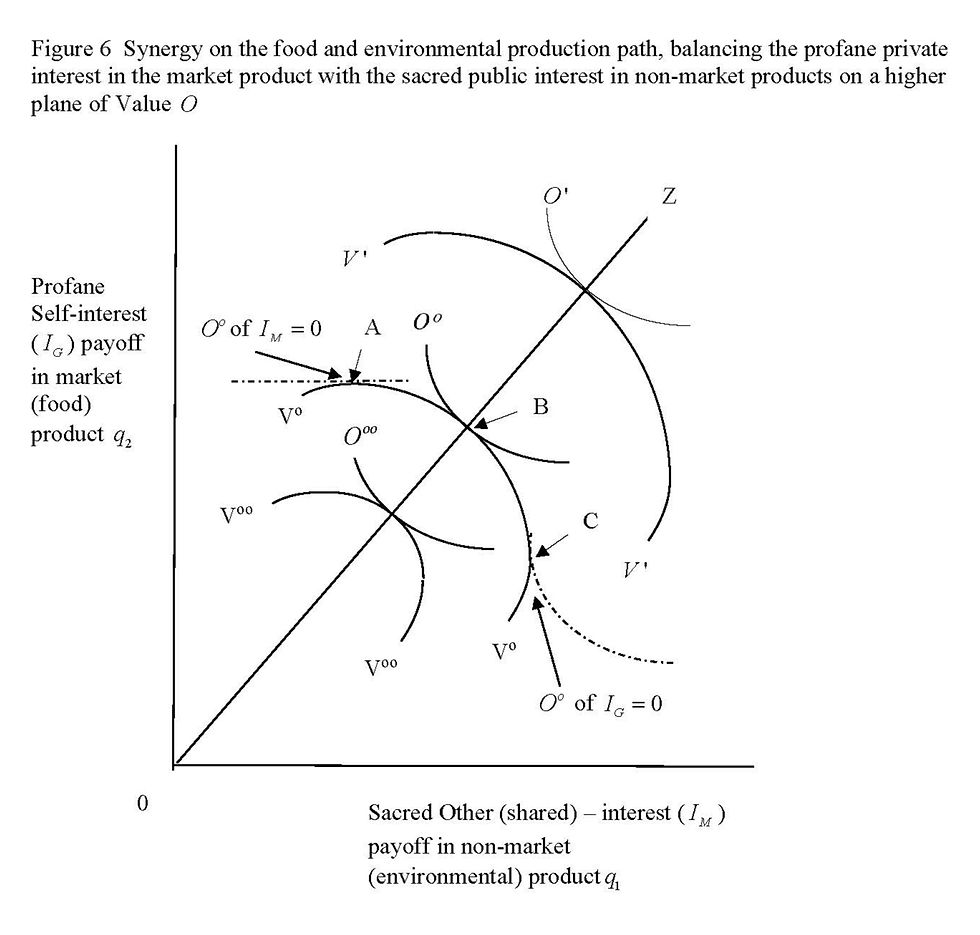
In effect, the 1981 Water Code put in place a water economy without regard for influence from the Other Forum represented in Figure 6.
Economic use for irrigation and hydropower electricity generation, both with price P came to dominate, focused on self-interest only on path 0G. Chileans started to work at modification after Chile returned to a democracy in 1990, bringing the sacred path 0M back into play.
The following review of Celume et al. (2026) serves to bring in the details of what has happened in Chile since the Bauer (2004) book was published. Celume et al (2026) draw on over 63 studies conducted since 1990 to make clear that substantive modifications made in 2022 put more attention to the sacred, as depicted in Figures 5 and 6 on path 0M. It is about working to shift the Chilean water economy over to better balance in the profane&sacred on path 0Z. The 2022 legislation, among other things which in effect all contribute to the move toward a more attenuated private property right, puts more attention to equitable access, water security, indigenous rights, sustenance as everyone must have access to water, environmental sustainability and river ecosystem health as in establishing ecological flows.
Agan, in DIT terms, the shift is away from path 0G (see Figures 5 and 6) representing an exclusive focus on individual good for economic purpose, and moving toward more attention to path 0M representing the common good. Said common good cannot generally be measured in money value price P, so the Market Forum fails to represent it, but is represented in non-money value O coming out of the Other Forum(s).
And, while the 1981 Water Code framed the organization of a Water Forum (represented in Figure 5) to help evolve and reveal price P, the 2022 legislation to modify the 1981 Water Code worked to bring more influence from the value O evolved in the Other Forums (represented in Figure 6) into play. The 2022 legislation is about rebalancing the joint profane&sacred, priceP&valueO, toward more attention to the sacred. So, here we go, with the details.


Comments