(Brief) Water Markets Are Not All That Free Market Environmentalism Claims

Updated: Aug 24
Preface: For an even shorter version of the Bauer (2004) review, see the Substack, which also has Audio Voiceover, so you can listen to a quick overview, at Water Markets Are Not All That Free Market Environmentalism Claims https://substack.com/home/post/p-212606926 . Also, a Detailed review, Chapter by Chapter, is available here in the Blog at (Details) Water Markets are Not All That Free Market Environmentalism Claims https://www.metaeconomics.info/post/siren-song-water-markets-are-not-all-that-free-market-environmentalism-claims . Both the Substack and this Brief review were developed with the help of Claude Sonnet 5.0, based on Claude processing the Detailed review written by Me ... so, the Brief and the Substack are Me&Claude, both acting as integrators).
Bauer (2004) in Siren Song draws on fieldwork from 1991–1995 and brings the story forward through 2004. Bauer first surveys the international debate over water policy, then explains why Chile's 1981 water code became the world's reference case for free-market water reform, and then points to the impending global water crisis that gives the debate its urgency. The title comes from The Odyssey: The Chilean move to free water markets, celebrated by advocates of Free Market Environmentalism (FME), has sung a Siren's song to would-be reformers elsewhere. The Sirens point only to the gains of free-market purity and stay oblivious to what lies below the surface. Bauer's argument, read here through the lens of Dual Interest Theory (DIT) which supports said arguement, is that reformers need to be lashed to the mast — or the ship runs onto the rocks of pure market reform. For the details on DIT, see Lynne (2020, 2025), and the FAQ page at FAQ - Frequently Asked Questions | Metaeconomics https://www.metaeconomics.info/faq-frequently-asked-question
Bauer wants to counter the superficial treatment Chilean water law has received from outsiders who wrote Chile into the FME story without examining what actually happened on the ground. He also wants to record the struggles of Chileans working to reform their own water institutions, and he calls for a more qualitative, interdisciplinary approach to law and economics — a story built with as much historical and empirical detail as thirty years of engagement with Chile could provide.
The DIT Lens
Dual Interest Theory (DIT) organizes this reading of Bauer. DIT starts from the individual person deciding how water will be used, and it insists that every Traveler on Spaceship Earth needs both liberty and dignity — self-interest and a shared stake in the common good. The theory is about the balance being struck between self&other interest, incentiveðic, the individual&common good, the profane (F) and the sacred (S), as in F&S. The “&” in DIT is more than grammatical convenience: It means the two elements are joint, nonseparable, arising together as joint operant,. Empirically, that balance for shows up as an interaction term FS sitting alongside F and S in an econometric model of water-related choice — the empirical counterpart of the overlapping isocurves in the DIT figures below (see Geometry of Dual Interest Theory | Metaeconomics https://www.metaeconomics.info/geometry-of-dual-interest-theory ).
Figures 1, 5, and 6, drawn from the forthcoming book Water Economy: Balancing the Profane and Sacred (building on Metaeconomics: Tempering Excessive Greed, Lynne 2020), give DIT its analytical content. Figure 1 represents demand and supply for the soil water used in agricultural irrigation — the water that, because agriculture claims the bulk of freshwater drawn from the Spaceship, is the water any new or alternative use must draw from.

Supply UM represents water left for irrigation once a substantial instream flow has been reserved for ecological purposes or for indigenous communities and smaller farmers — more the domain of the sacred. Supply UO represents the marginal cost of applying water to irrigated crops when the sacred is set aside and the focus runs exclusively to the profane, especially high-value crop production; in some treatments UO becomes the horizontal axis itself, as when agronomists recommend the WET associated with maximum yield. The DIT-relevant curve is UZ, which reflects both economic and social efficiency and strikes balance in the profane and sacred jointly.
DIT represents the jointness in the interests with isocurves, as illustrated in Figure 5. The path 0G through the ego-based self-interest only space is identical to that in Single Interest Theory (SIT) in mainstream Microeconomics. DIT adds the isocurves for the empathy-based other (shared)-interest with path 0M. DIT also sees economic and social efficiency arising on path 0Z, with good balance in self&other-interest.

So, moving up path 0G gives the traditional, mainstream demand DO in Figure 1; moving up path 0M gives demand DM; moving up the best path 0Z gives demand DZ. The overlapping isocurves in Figure 5 are the empirical reality of FS as a genuine interaction term — the profane and sacred are jointly determined, each dependent on the other. Single Interest Theory (SIT), the mainstream neoclassical and especially neoliberal-libertarian frame behind FME, attends only to path 0G: only F is operant, and neither S nor FS has a place. That is a theory built on a make-believe Econ, a self-interest-only person — cargo-cult science, not empirical science (Lynne 2025). DIT, by contrast, is built on the understanding, present in the intuitions of the classical economists as well as in modern behavioral science and neuroscience, that the human evolved to balance the profane&sacred, the me&we.
The story does not end there. The human also weighs money value (price P) and non-money value (O) — the old pushpins&poetry problem in economic philosophy, addressed in the Other Forum space represented in Figure 6.
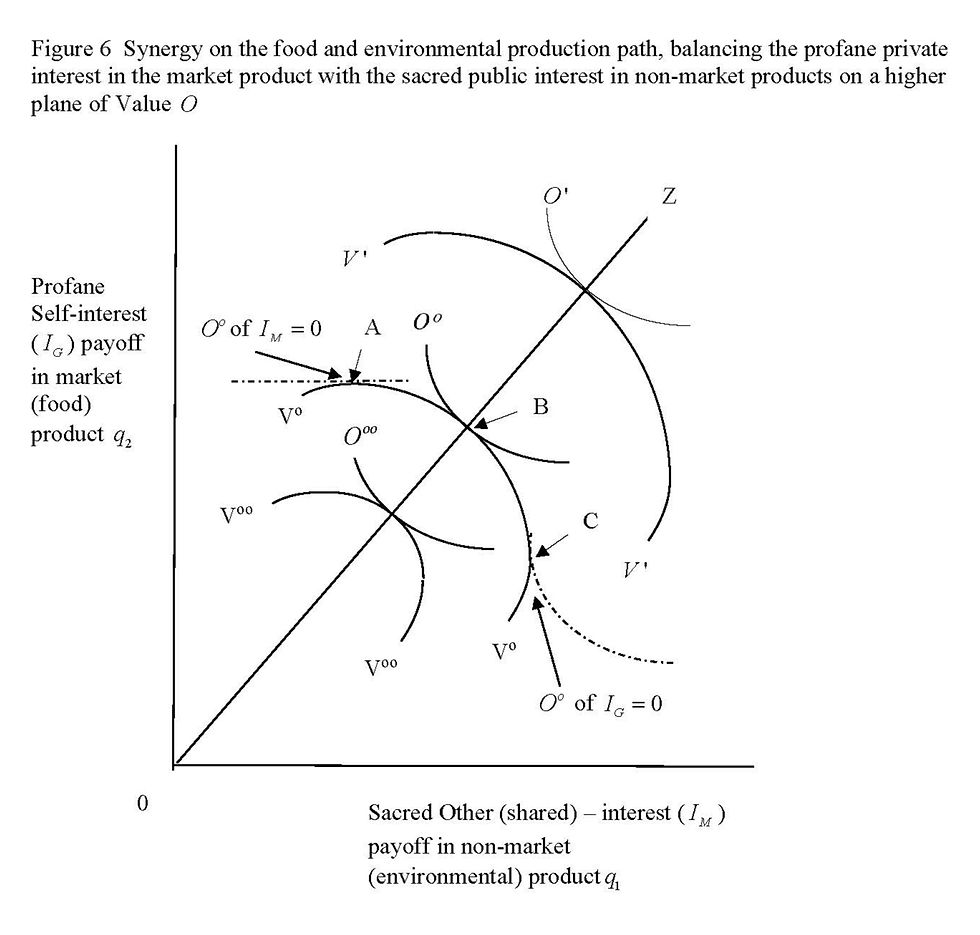
Figure 6 gives the Other Forum its role: Bringing the non-valued social equity and environmental protection with value O into view, and giving legitimacy to the priceless value O attached to sustaining the hydrologic system. The Other Forum, given structure through Ostrom's IAD design principles (Cox, Arnold, and Tomás 2010; Ostrom 1991, 1993, 2009; Wilson 2015), is what allows value O to inform the price P that evolves in the Market Forum of Figure 5. The review that follows applies this analytical system — Figures 1, 5, and 6 — to what Bauer found in Chile.
Chile Becomes the World's Reference Case
Chile's 1981 water code made it the textbook example of FME: Water rights treated not merely as private property but as a fully marketable commodity. Some observers outside Chile declared the privatization a success without examining it closely. Bauer set out to test that claim and found real weaknesses alongside some genuine strengths. The weak points cluster in social equity, environmental protection, river basin management, coordination among multiple water uses, and conflict resolution — areas the 1981 code and the 1980 constitution were never built to handle, resting as they do on a broadly defined private right to water, tightly restricted regulatory authority, and an erratic judiciary poorly equipped for public-policy questions.
Through the DIT lens this is unsurprising: The 1981 code reflected an imposition of market fundamentalism, and neoliberal policy predictably delivers mixed results when the shared other-interest has no institutional home. Reform efforts after the return to democracy have made little headway; the neoliberal order dug in.
The Free-Market Model and Its Lineage
Bauer traces a genuine pendulum. Chile's first water code (1951) struck a reasoned balance — private rights conditioned by government oversight, including a use-it-or-lose-it provision much like western U.S. water law, and rights tied to land ownership. In DIT terms it was an attempt, however constrained, at path 0Z. The second code (1967), part of agrarian reform, swung the pendulum hard toward path 0M: Water became public property for public use, subject to expropriation, with government technicians setting allocations — a hard-& (controlling, coercive) move, ambitious but starved of resources to execute.
The 1973 military coup and the subsequent embrace of neoliberalism reversed direction entirely. By 1979 the 'Chicago Boys' (Libertarian Economists trained by Milton Friedman and others at the University of Chicago; in fact, Friedman became a kind of spokesperson for the imposition of market fundamentalism in Chile) controlled economic policy and framed public ownership of water as the source of underinvestment. Decree Law 2603 declared that recognized water rights would confer full property in those rights, separated from land, freely bought and sold, and taxable like real estate — a wholesale move onto path 0G, water framed exclusively as a commodity with no accord paid to the sacred. Traditional engineers, lawyers, and, notably, many irrigators themselves pushed back: irrigators wanted secure private rights but did not particularly want an active trading market, and did not believe transferability would improve efficiency.
The final 1981 Water Code, embedded in the 1980 Constitution written under military rule without public debate, gave water use rights full private-property status — freely bought, sold, mortgaged, inherited, like a kind of real estate — while nominally retaining water as public property. In practice the General Water Directorate (DGA) grants new rights free of charge whenever water is available and then loses essentially all regulatory authority over them; rights carry no obligation to use the water and no penalty for leaving it idle, a feature unique among the world's water laws and an open invitation to speculation. Disputes go to the civil courts. River basin coordination, environmental protection, and water quality fall outside the code's reach entirely. Through the DIT lens, the neoliberal design has no placeholder for the Other Forum — the institution that would give the Market Forum context — so none was built.
Reform Under Democracy
Chile returned to civilian government with a democracy in 1990, but the 1980 Constitution — and with it the neoliberal water-rights framework — stayed in place, amendable only by constitutional supermajority. Reformers spent 1990–2004 trying to move the pendulum back toward some accounting of the public good, and largely failed. A 1992 bill would have affirmed the public character of water rights, created an agency to protect water quality and instream flows, established river-basin management agencies, and tightened use-it-or-lose-it enforcement. The use-it-or-lose-it provision and the river-basin agencies drew the fiercest opposition, framed by the political right as symbolically anti-market. A nonuse fee, modeled on Chile's mining-rights law, went nowhere and was eventually abandoned; a broader water-use tax fared no better. By 2004 neither had passed, and 'the same set of private sector interest groups, neoliberal policy analysts, and right wing politicians' (p. 65) that resisted reform in 1990 was still resisting it.
The underlying dispute, as Bauer frames it, was never really about tax mechanics. It was about whether any part of Chile's water remained public property at all. Every reform that opened that door — nonuse fees most of all — met concerted resistance, because conceding the point would concede the whole neoliberal premise. Through the DIT lens this is the expected behavior of an ideology with no room for the shared other-interest: Any regulation, however modest, gets cast as the first step toward state socialism, a trope with roots in a selective reading of Hayek (1944) that Hayek himself never endorsed (see The Two Roads to Serfdom https://www.metaeconomics.info/post/the-two-roads-to-serfdom ).
What Twenty Years of Empirical Research Actually Shows
Bauer's central empirical finding is blunt: The Chilean water-market literature through the 1990s was “long on theoretical or ideological argument and short on reliable information” (p. 75). Early studies, including several from the World Bank, claimed active trading, efficiency gains, benefits for poor farmers, and fewer conflicts — claims that unraveled once anyone looked for the data. Very few water trades actually occurred, then or through 2004, and the claims that early allocations favored poor farmers rest on a discredited account traced back to a Chilean official who had himself helped assign the rights under the military government.
Bauer identifies four reasons trading stayed thin: Chile's rivers are short and steep, making interbasin transfer physically and financially costly; legal and administrative recordkeeping on who holds what right is poor; farming communities carry real cultural resistance to treating water purely as a commodity --- in DIT terms, seeing the sacred dimension of water not just the profane; and price signals are inconsistent, with rights holders reluctant to sell against the risk of drought. Where researchers did find some active trading — the Limarí River Basin, held up as the market's poster child — the conditions that made it work were public investment in reservoir storage and well-organized local water-user associations: An Other Forum, in effect, that the neoliberal design never intended to require.
Across the literature, the same five issues go missing, again and again: social equity, river basin management, coordination among multiple users, conflict resolution, and environmental protection.
As DIT makes clear, that absence is not an oversight — it follows directly from researchers applying SIT (Single Interest Theory, self-interest only in neoliberal and libertarian economics), a lens with no placeholder for the shared other-interest. On equity, few peasants or small farmers received rights in the initial allocation, they can participate in trading only as sellers of rights they mostly don't hold, and they lack the resources and standing to compete in an unregulated market; the equity research simply was not done.
On river basin management, Bauer points to Chile's near-total absence of institutional coordination. Through the DIT lens, Chile needs something akin to Florida's Water Management Districts, one for each hydrologic region, created by the 1972 Florida Water Resources Act. Said Districts have functioned for decades with professional staff and public-trust authority over water — exactly the kind of Other Forum Chile never built. In Chile, each river basin could be a kind of District, representing an Other Forum in each river basin.
Conflict resolution fell to the civil courts, with predictable results. The proposed Laja River interbasin transfer collapsed only under public-relations pressure, not through any institutional process. The Maule River dispute between a privatized power company and downstream irrigators dragged through the courts for years and was never resolved.
The Pangue Dam case on the Bio Bio River went to the Chilean Supreme Court, which ruled that irrigators harmed by upstream diversion could sue only after damage occurred — in effect transferring wealth from irrigators to the power company without compensation, while a University of Chicago economist defended the outcome on the assumption of zero transaction costs using the fabled Coase Theorem. Through the DIT lens, it is noteworthy that Coase never proposed the 'Coase Theorem' --- it was attributed to him by libertarian economics. Coase fully understood transaction costs are never actually zero — in DIT terms, said costs are precisely the cost of building and operating the Other Forum that lets a Market Forum function at all.
Bauer's Conclusions
Looking back from 2004, Bauer's balance sheet is mixed. On the credit side: Legal security of property rights improved; government regulation shrank; some water moved to higher-value uses; local water-user organizations gained more autonomy; and non-consumptive rights spurred hydroelectric development. On the debit side, and a considerably longer list: It remains unclear that free trading actually improved efficiency; the government still subsidizes canal and infrastructure investment the market was supposed to attract; market activity stayed thin outside a few desert regions; rights definitions and hydrologic data remain inadequate; poor and small farmers saw little to no benefit; and private bargaining has failed to resolve conflicts between hydroelectric and agricultural interests or to check speculation and concentrated ownership among non-consumptive rights holders.
Bauer's own list of what still needs attention includes dropping the fight over nonuse fees; putting water taxes on a longer legislative timeline; building river-basin coordination institutions --- in DIT terms, applying something like Ostrom's IAD principles to new Other Forums, working to minimize transaction costs; developing legal mechanisms for basin-level conflicts; protecting instream environmental flows; inviting environmental and social NGOs into the process; and sustaining a real research partnership between universities and government. Every item on that list is, in DIT terms, a call to build the Other Forum that the 1981 code never provided.
As Bauer puts it, the case that needs making is “… against ‘free’ markets and narrow economics, not against all use of market-based instruments and analysis in water management” (p. 135). In DIT terms, water needs to be managed jointly as a private&public good, through an integrated market&other forum, not a market alone.
Beware the Siren Song: Three Roads to Serfdom
The deepest lesson in Bauer's account is that Chile did things backward. The Other Forum of Figure 6 should have come first, giving the Water Forum of Figure 5 the institutional context to function. Instead, Chile installed the Water Forum wholesale and left the Other Forum for later — later still has not arrived, twenty years past Bauer's account and more than forty years past the 1981 code.

Putting all this in larger context: Hayek (1944) warned against state Socialism — all property public, on or below path 0M — the road to state serfdom (again, see The Two Roads to Serfdom https://www.metaeconomics.info/post/the-two-roads-to-serfdom ). The Neoliberals after World War II, and especially the Friedman frame that produced Free Market Environmentalism, pushed the opposite extreme: All private property, on or above path 0G, leading to greed Scroogism --- the road to greed serfdom (see The Two Roads from Mont Pelerin https://www.metaeconomics.info/post/the-two-roads-from-mont-pelerin ).
Both extremes fail, and when a system fails a demagogue with authoritarian tendencies tends to arrive promising to fix it — Pinochet in 1973 Chile after the failure of state socialism, the pattern repeating wherever the pendulum swings too far in either direction. The crash lands on the road to authoritarian serfdom (see (SHORT VERSION) THE THIRD ROAD TO SERFDOM: AUTHORITARIAN NATIONALISM https://www.metaeconomics.info/post/short-version-the-third-road-to-serfdom A similar thing is happening in the United States with Trump elected in 2024. The assault on the public lands and natural resources with privatization in view is underway. Be aware.
Chile's own trajectory traced this arc — crashing out of state socialism into authoritarian rule, which then imposed greed Scroogism on Chileans whether they wanted it or not. Bauer intuitively grasps the larger stakes: the Chilean pendulum swung too far, from one road to serfdom to the other. The way off either road, and to avoid the road to authoritarian serfdom, is the balanced path 0Z — as suggested by DIT, the balanced road to prosperity, reached only by striking a reasoned balance in the joint profane&sacred.
Bauer's Siren Song is, supported by DIT, in the end, an argument for lashing water reform to that mast.
References
Bauer, Carl J. Siren Song: Chilean Water Law as a Model for International Reform. Washington, D.C.: Resources for the Future, 2004.
Cox, Michael, Gwen Arnold, and Sergio Villamayor Tomás. “A Review of Design Principles for Community-Based Natural Resource Management.” Ecology and Society 15, 4 (2010): 38.
Lynne, Gary D. Metaeconomics: Tempering Excessive Greed. Palgrave Advances in Behavioral Economics. New York: Palgrave Macmillan, 2020.
Lynne, Gary D. “Cargo-Cult Economics to Metaeconomics: Toward a Humanomics with a Theory.” Review of Behavioral Economics 12, 3 (May 2025): 257–289.
Ostrom, Elinor. Crafting Institutions for Self-Governing Irrigation Systems. San Francisco: ICS Press, 1991.
Ostrom, Elinor. “Design Principles in Long-Enduring Irrigation Institutions.” Water Resources Research 29, 7 (July 1993): 1907–12.
Ostrom, Elinor. “Beyond Markets and States: Polycentric Governance of Complex Economic Systems.” Nobel Prize in Economics Lecture, 2009.
Wilson, David Sloan. Does Altruism Exist? Culture, Genes, and the Welfare of Others. Foundational Questions in Science. New Haven: Yale University Press, Kindle Edition, 2015.


Comments