(Details) Water Markets are Not All That Free Market Environmentalism Claims

Updated: Aug 28

The book by Carl J Bauer titled Siren Song (2004) reflects research during 1991 and 1995, and then bringing it up to date on what happened during the period of 1996-2004. For the backgrounding here, regarding Free Market Environmentalism, see Free Market Environmentalism (FME) Fails to Tell the Whole Story and Fallacies of Free Market Environmentalism . as represented in books like Anderson and Leal (1991/2015).
Bauer (2004) first gives a historical overview, followed by highlighting the significance of the Chilean model for international debates about water policy. He then points out the impending global water crisis. And, the reason for the title of the book: The Chilean move to free water markets favored by FME has been like a song of the Sirens (after The Odyssey) to would be reformers in other countries. Said Sirens point only to the gains from applying free-market purity and are in general oblivious to the risks below the surface. Bauer in effect is pointing to the reformers needing to be lashed to the mast, supported in that view through the DIT lens, else the ship on the water goes on the rocks of pure market reform.
Bauer points out how he wants to counter the superficiality of many characterizations and descriptions from researchers and commentators from outside Chile --- which is represented in FME --- of Chilean water law and policy. At the same time, he wants to bring the story to light about Chileans, and the nature of local struggles and challenges in working to reform the Water Forums operating in Chile. He also calls for a more qualitative interdisciplinary approach to law and economics. He points out how the story he weaves in the book reflects his long-standing efforts to understand the local complexities of Chilean politics, culture, and geography with as much historical richness and digital detail he can manage.
DIT Lens Used Here
Dual Interest Theory (DIT) from Metaeconomics is used here to frame and help make sense of the Bauer claims. DIT acknowledges the key role of the individual person in making decision about how water will be used and abused. DIT sees the essential need for every individual to have liberty and freedom, dignity and equality (meaning in the sense of social cohesion, solidarity, shared interest in the common good as related to water) for every Traveler on the Spaceship Earth.
So, DIT is also about the responsibility of said Traveler, as the focus is on striking balance in self&other-interest, incentiveðic, individual&common-good, the profaneF&sacredS. As an empirical variable, the latter would be represented in an interaction term FS, which would reside in the same equation with F and S in an econometric model examining water related behavioral choices (see https://www.metaeconomics.info/geometry-of-dual-interest-theory ). Said interaction is the empirical representation of the overlapping isocurves in a DIT styled figure.
DIT Analytical System
DIT is given analytical content with Figures 1, 5 and 6 from my forthcoming book Water Economy: Balancing the Profane and Sacred, building on Metaeconomics: Tempering Excessive Greed (Lynne 2020). The figures direct attention at water used for agricultural irrigation, as the bulk of the fresh water being directly used on the Spaceship has been set aside for irrigation to support food production. So, any new and/or alternative use must in general reduce water used in agricultural irrigation. The demand and supply for available soil water (representing the consumptive use in irrigation) is represented in Figure 1, which is the water that could be reallocated to another use.

The supply U curves represent water supplied to more industrialized, agricultural irrigation system under different allocations. For said case, supply UM would then represent a greatly reduced supply for industrial irrigation as related to leaving a substantive instream flow of a river for ecological purpose, or for purposes of setting water aside for indigenous communities or smaller farmers, both more in the domain of the sacred. In such cases, more of the water might be held back from use in industrial irrigation, with social optimum at WM made available for irrigation.
Now, if the focus instead is irrigation and production from it, like in assigning the water to irrigators, perhaps even giving private property in water to said irrigators, supply UO would be a case. Said supply UO represents the marginal costs of applying the water to the irrigated crops. If the sacred is ignored, and the focus is put exclusively on the profane (i.e., crop production, especially high value crop production), that kind of economic efficiency is accomplished with WO made available to the irrigation process. And, in some cases, supply UO becomes the horizontal axis, especially if recommendations for the amount to apply by agronomists and agricultural engineers are followed, as in the idea of maximizing yield, which needs the WET (the evapotranspiration associated with maximum yield) made available to irrigation.
Through the DIT lens, the relevant curve is supply UZ. It reflects both economic&social efficiency. It works to strike balance in the profane&sacred, which is given content in Figures 5 and 6.
Figure 5 represents the Water Forum of FME. Moving up the profane path 0G in Figure 5 gives the demand DO in Figure 1. Moving up the sacred path 0M gives the demand DM. Moving up the best path 0Z gives the demand DZ.

Figure 5 also makes clear the jointness in the profane&sacred dimensions of water, as in each influencing and dependent upon the other, which is the key feature of Dual Interest Theory (DIT). The overlapping isocurves represent the empirical reality of FS being a key variable of interaction. It represents the interdependence in a behavioral equation reflecting F and S in explaining economic choice in the use and abuse of water (again, see https://www.metaeconomics.info/geometry-of-dual-interest-theory ).
Notice that Single Interest Theory (SIT) in mainstream Microeconomics as especially applied by Neoclassical Economists, and especially the Neoliberal Economists with a Libertarian frame of reference who favor FME, focus exclusively on path 0G outcomes in the domain of the profane. In said case, only F is operant without regard for either S or FS. The sacred is not a part of SIT, which also makes it a theory based in cargo-cult (make-believe) science (see Lynne 2025). It is a make-believe science about an Econ, a self-interest only person. DIT is built on the understanding (both in the intuition of the classical economists like Adam Smith, but also supported in modern behavioral and neuroscience) that the Human evolved to balance the profane&sacred, the me&we, the self&other-interest, the incentiveðic. DIT represents that fact in the two sets of overlapping isocurves in Figure 5.
But the story does not stop with that claim. It is also the case that the Human sees both the profane money value represented in price P and the sacred non-money value O as part of reality. Figure 6 brings that other key feature of the evolved Human, the need to balance money&non-money values, priceP&valueO, as represented in the old (in economic philosophy) pushpins&poetry problem.
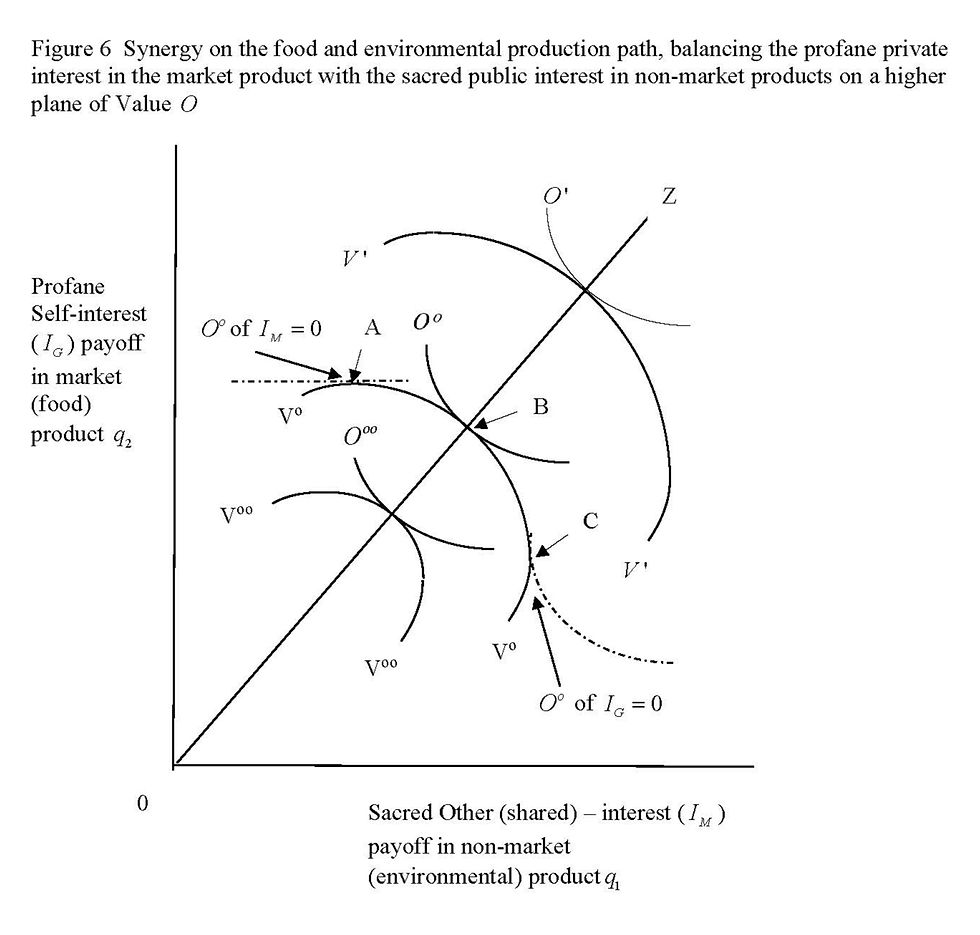
Figure 6 points to the key role of the Other Forum in resolving the pushpins&poetry problem, especially in bringing in social equity and environmental protection into view. Somethings about water are indeed priceless, as in having value O. The latter is especially about sustaining the hydrologic system on the Spaceship Earth which is in effect priceless, having only value O. And, in DIT, by bringing value O into view, the Other Forum in Figure 6 gives context and influences the price P evolving in the Market Forum of Figure 5.
And, an important aside: In DIT, the Other Forum is given substance through applying the Ostrom IAD principles (Cox et al. 2010; Ostrom 1991, 1993, 2009; Wilson 2015), giving rise to a functional Other Forum that can address the balance in the jointly operant profane(pushpins)&sacred(poetry) dimensions of water. It is not just about the money value of water evolved as price P in a Market Forum represented in the Figure 5, but is also about the non-money value O of water found and expressed in an Other Forum represented in Figure 6.
The following review is done through the DIT lens given analytical traction in the constructs represented in Figures 1, 5, and 6.
INTRODUCTION: THE CHILEAN WATER MODEL COMES OF AGE
Bauer points out how Chile has become the world's leading example of the free market approach touted in FME to water law and water resources management. Chile has come to represent a kind of textbook case of treating water rights not merely as private property but as a fully marketable commodity.
It all started in 1981 with the new Chilean water code. Some outside of Chile have declared it was a success to privatize all the water. The flaws have not been seriously considered.
Bauer plans to challenge that claim. Bauer has found many weaknesses as well as some strengths in the market model. The poor performance has been in such areas as social equity, environmental protection, river basin management, coordination of multiple water uses, and resolution of water conflicts. The 1981 code along with Chile's 1980 constitution has been incapable of addressing these issues. It seems that both have been supporting a strong and broadly defined private right to water for economic purpose, tightly restricted government regulatory authority, and a powerful but erratic judiciary not trained in public policy issues and holding a narrow and formalistic concept of law (p .2).
Bauer then also works to draw implications for international water reform. Bauer wants to emphasize the “legal, social, and political aspects of economic analysis.” Bauer points out that neoliberal policies have had mixed results, which is to be expected when one looks through the e DIT lens, in that the 1981 water code reflected an imposition of market fundamentalism on Chileans. Bauer points to how an effort to reform the 1981 water code has been largely to no avail. The neoliberal order has dug in.


Comments