Fallacies of Free Market Environmentalism

This review of Blumm, Michael C. "The Fallacies of Free Market Environmentalism." Harvard Journal of Law and Public Policy 15 (1992): 371–89 comes through the lens of Dual Interest Theory (DIT) in Metaeconomics. DIT exposes the fallacies of Single Interest Theory (SIT) in Microeconomics, and thus in Free Market Environmentalism which rests in claims from SIT.
Blumm (1992) is primarily commenting on the work of Anderson and Leal (1991, which was revised in 2015) in the book Free Market Environmentalism. But, overall, it is a general commentary on the push to move all manner of environmental resources --- especially water but all public land --- into the domain of private property so the Market Forum would then play the dominant role in allocating and reallocating water, as well as all manner of other natural and environmental resources. And, while that push was most active in the 1980s and 1990s, it certainly has not gone away.
The tendency was in full play in the 1980s to early-1990s following on The Neoliberal Order 1970-2008 --- and it has come back in force in the US after the 2024 Election, with the plan to open up the public lands, and do things like eliminate the endangered species act in order to exploit the environmental resources.
The approach was especially in play in the 1980s-1990s in the Markets can do wrong claims of the Reagan (and Thatcher in England) Revolution, and is now back in play here in 2026, It is well best described by what Blumm (1992) calls the action of the Privateers, as Free Market Environmentalism works to “dismantle environmental regulatory programs and free allocation of environmental resources to the workings of the marketplace. Notable among these ‘Privateers’ are Terry Anderson and Donald Leal, the Pacific Research Institute, and my colleague, Jim Huffman. … (said) Privateers distrust democracy deeply. They believe that the public interest is simply the accumulation of individual costs and benefits, no more. Thus, they advocate marketplace exchanges, measured by willingness to pay money, as the best barometer of the social will. The Privateers insist that public values do not exist apart from the aggregation of individual values, and the individuals who count for the Privateers are property owners alone. This atomistic view of society glorifies market exchanges, discounts market failure, and decries governmental intervention. The Privateers indict the democratic process as dominated by special, self-serving interest groups engaging in ‘rent-seeking" and deny that public dialogue can ever subsume private preferences… (said) Privateers' argument appeals to the libertarian in all of us (pp. 371-372).”
In DIT terms, Government intervention rather than representing something to be avoided can actually tamp down rent-seeking, as intervention is about the oft times need for hard-& in striking the balance in the profane & sacred. Rent-seeking is profane; it could be banned. And the reason? Well, it does not meet ethical standards, representing what reasoned people can go along with in the domain of the sacred. And, while soft-& --- the sacred influencing the profane --- is in effect presumed in Free Market Environmentalism (if it sees the sacred at all), it does not always happen. Said rent-seeking also occurs in Markets when people fail to temper the excesses, ignoring the common good in the trade. Even in people who may proclaim the sacred is important, the failure in self-command to act on it is common.
Using the DIT Lens to Add Understanding of the Blumm 1992 Review
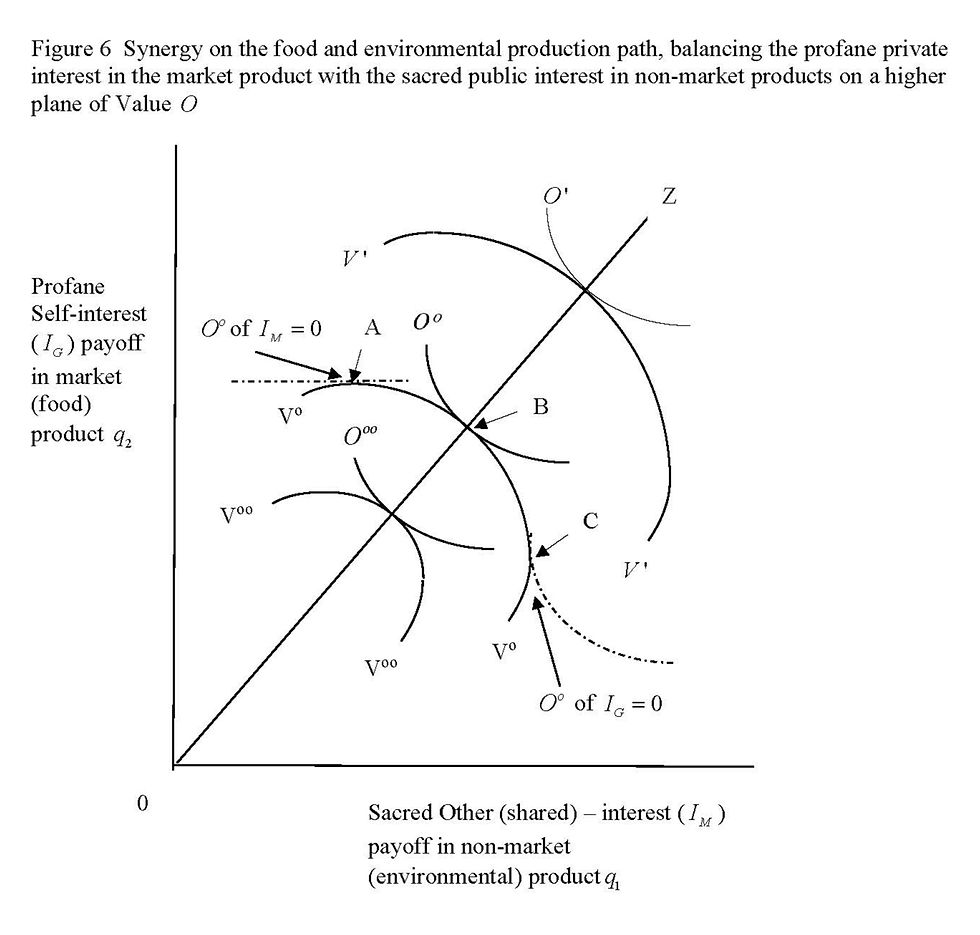
The Blumm review of Anderson and Leal is brought into view here through the DIT --- Dual Interest Theory --- lens. It refers to the Figure 5 and Figure 6 in a book (building on Lynne 2020; Lynne and Saarinen 2022) in process titled Water Economy: Balancing the Profane & Sacred.

Notice the self-interest profane domain of SIT (and Free Market Environmentalism) is mainly the focus on path 0G, while DIT points to the need to also put some attention to the sacred other (shared with the other)-interest on path 0M. Also notice the key feature of Figure 5: The profane (F) & sacred (S) cannot be separated into separated accounts for simple trade-off. It is about FS, as in each dependent upon the other, arising jointly. It is also an argument now made by self-professed as reformed libertarian economist, and now economic historian, Deirdre McCloskey, as in the profane incentive must be tempered by the sacred ethic, and by denying the role of the ethic, SIT in Microeconomics has become a make-believe, cargo-cult science See Lynne 2025 for a review of the 7-books by McCloskey that lead to this finding, and for a quick overview of the FS jointness phenomenon at Geometry of Dual Interest Theory | Metaeconomics .
As DIT makes clear, the best path is in a balance struck in the profane (incentive) & sacred (ethic) on path 0Z. And, as DIT emphasizes, ideally it would the soft-& influence of the sacred on the profane Market, and not the hard-& control of the Government on the Market to bring about some better path 0Z. DIT clarifies the need to have both the Market Forum & Other Forum, Market & Community of Shared Interest, the latter represented in an inclusive Government in play in order to resolve environmental issues.
Better Understanding the Libertarian in All of Us
The libertarian in all of us alluded to by Blumm (1992), with said libertarian the main actor in Anderson and Leal (1991), would like to do as we please with limited influence from others. Said libertarian would certainly not face any outside control, as in environmental regulation. DIT refers to said frame as the desire for complete autonomy on some path 0G --- closer to the vertical axis the better --- in Figure 5.
In libertarian terms, some profane path 0G near the vertical axis in Figure 5 is the preferred path, with little to no regard for what is sacred as represented on path 0M, The latter is defined by what reasoned people can go along with, as in the environmental ethic guiding environmental use and abuse.
The libertarian in all of us also denies the validity of an Other Forum working with Democracy based framing to evolve and represent the non-money value O, as depicted in Figure 6, as in distrusting Democracy to find what is best. It is a denial for what DIT labels as homonomy, meaning influence from the path 0M, in a soft-& in the balance in the profane & sacred. Such Homonomy would be represented in a soft-& influence, a nudge, by the Community and the Government representing it, as in Market & Community: Government, the “:” meaning an inclusive of all, representative Government.
As noted, the libertarian in all of us not only does not want homonomy, and especially denies any role for heteronomy --- hard-& control from the Community: Government to impose a balance in the profane & sacred --- which means denying any outside control from the frame of path 0M. The libertarian privateer wants no influence of said value O on price P in the Market Forum: Track on path 0G and ignore path 0M. The essential influence on the location of the economically and socially efficient path 0Z is denied, whether achieved by soft-& and/or hard-& means --- no regulation, no oversight, do as you please --- claiming efficiency can only be on the unfettered path 0G.
Another way to say it, the fact is, as Blumm says it: “Markets (with a libertarian frame) persistently fail to yield efficient or fair allocations of environmental resources, because in large measure they produce poor information on the costs that those breathing polluted air, drinking contaminated water, or threatened by toxic exposures bear (p. 379).” Absolutely. And, while libertarians claim Markets are smart and Government is dumb, well, the reality is that Markets are dumb, while the Government is smart, in so many essential arenas.
Cases in point include the Government being smart in knowing the capacity of an aquifer to be pumped or the river to be diverted while still supporting the essential ecosystem of the Spaceship. It all depends upon knowledge of the situation, including science & humanities based knowledge, as well as day-to-day experiential knowledge.
Do individuals in the Market always have more information and knowledge than some Other Forum, helped by some Government Agency with a competent, professionally trained staff? It is often if not always the case that Government agencies with competent researchers and civil servants are better at such information than is the Market. The Government is better at a lot of things, especially in bringing the latest science & humanities based knowledge into view.
Also, perhaps most importantly, an inclusive and truly representative of the shared other-interest of the Community styled Government brings empathy-with into play, producing the value O. It is about an inclusive Democracy based Other Forum helping when self-command of individuals fails to temper the excesses, like in polluting the water and air. In general, Markets are dumb while Government is smart at bringing value O, the non-money values, into play.
The Privateers also misrepresent the real nature of Humans. Like Blumm says it: “How many of us know only rational, wealth-maximizing, rent-seeking individuals; know no individuals whose moral compass includes non-economic values? …The fact that the Privateers write about people we do not know, coupled with their absolutist perspective on markets and regulation, makes it tempting to dismiss them as extreme right wingers, anarchists, or both-and some indeed are (pp. 372-373).” Well, mainstream economics and the use of SIT is about right-wing ideology disguised as science, so this is not a huge stretch. SIT supports the Free Market Environmentalism claims of only self-interest at play (all are Econs) in both the Market and the Government. As DIT clarifies, Humans do respond to incentives and may seek rents, but truly functional Humans have ethics and temper said primal drives. And, when said Humans do not practice that self-command, then Government can --- reflecting that ethic of what is reasonable --- justifiably assert some control, like setting a cap on how much water can be drawn from an aquifer, and the amount that can be diverted from a river.
Blumm (1992) does acknowledge incentives (the only concern in Free Market Environmentalism) are important, but also sees the reality of transaction costs in play to represent the shared other-interest, the ethic: “To minimize transaction costs and conserve limited administrative resources, environmental regulators must examine their programs to maximize individual incentives. This may well include versions of privatization, such as transferable emission rights, but will hardly include a wholesale substitution of the environmental regulatory system, as Free Market Environmentalism advocates (p. 373).” As DIT makes clear, the transaction costs are at play in the Other Forum, which needs to minimize same in bringing the value O into play to temper the price P of the Market. And, yes, it is about striking good balance in the Incentive & Ethic, Market & Other, Market & Community: Government, the latter reflecting the environmental regulatory system.
Blumm (1992) Has Four Main Parts
Blumm (1992) gives an overview of the plan in the essay:
“Part I of this essay supplies background on markets and environmental protection, showing why market failure makes regulation necessary and explaining the new environmental Privateers as intellectual descendants of Ronald Coase and the half-brothers of what has become known as Public Choice theory (p. 373).” Yes. The Privateers use an old and tired story going back to the Coase Theorem and Public Choice Theory, shored up by Single Interest Theory (SIT) in mainstream --- especially libertarian --- economics that claim only self-interest is to be given any attention. The claim fails to see the dual nature of the Human, who seeks balance in the self & other-interest. Humans are not just Econs pursuing only self-interest. Ironically, rather than achieving efficiency, the points to pursuing the suboptimal, economically and socially inefficient profane path 0G. And. the closer to the vertical axis (the more profane) the better, as in being opposed to any ethical reflection about what might be sacred.
“Part II criticizes Free Market Environmentalism for its failure to see the inadequacies inherent in marketplace ordering of environmental resources and for its misunderstanding of the reasons underlying governmental intervention (p. 373).” In DIT terms, the market fails to reflect the value O, as in the non-money values which dominate the domain of the sacred. Government is not intervening: It is working to facilitate the evolving value O in the domain of the sacred, such as to temper the outcomes represented in price P in the domain of the profane.
“Part III explores some of the costs of privatizing environmental decision making
that Anderson and Leal fail to recognize (p. 373).” Privatizing fails to see that the transaction costs that would be minimized with adequate attention to the shared other-interest in the sacred through the Other Forum will not be maximized. The profane Market will seize to function, and will not achieve economic and social efficiency because of the high transaction costs.
“Part IV concludes by suggesting that the future role of privatization techniques will
lie as a means to supplement, rather than substitute for, modern environmental regulation (p. 373).” As DIT makes clear, some limited role of the Market Forum represented in Figure 5 is actually essential to achieving economic and social efficiency on path 0Z, made possible because of the Other Forum represented in Figure 6. It is about striking balancing in the joint application of the Market Forum & Other Forum, the Market & Community: Government, the latter represented in an inclusive Democracy. Each is essential to the other.
We now consider each Part in depth. Again, the consideration is through the DIT lens, which sees a role for both the Market & Government, as long as the latter is an inclusive representative of All the People. It is about something akin to a Democracy based Constitutional Republic like historically has operated in the United States since the 1787 Constitution was put into play. And, and important aside here in 2026, it is not about a vertical power rule of men Authoritarian (“Christian, as in pseudo-Sacred”) Nationalism in the form of an Autocracy: That is not the Other Forum envisioned in DIT, which needs a horizontal rule of all the people involvement in ensuring a sustainable environmental system.
I MARKET FAILURE, ENVIRONMENTAL PROTECTION, AND THE PRIVATEERS
On the Coase Theorem: Coase never proposed said theorem, because he knew there were always transaction costs ... and, as DIT makes clear, said costs are minimized in finding the best path 0Z in the Other Forum, which then translates into lower transaction costs in the Market Forum. The Theorem was ascribed to Coase but it was not in the Coasian framework. Also, "fallible administrators" working in an appropriate Other Forum are no more fallible than participants in a Market. The currency is just different, as it points to the old incommensurability problem of balancing the attention to pushpins (profane) & poetry (sacred).
The problem is that the Market Forum cannot adequately represent the sacred: “Coasian disciples like the Privateers overlook these market limitations, while extolling the virtues of free markets and denouncing the vices of government regulation (p. 374).”
“… because of their conviction regarding the pernicious consequences of regulation.. . A new group of scholars, subscribing to what has become known as Public Choice theory, shares their skepticism of governmental solutions. Public Choice theorists bring economic theory to political science through models that view the political process as a system by which individuals and groups may further their own interests. Their assumption is that political participants use government intervention in the economy to further the welfare of the politically influential. This essentially selfish, "rent-seeking" view of the political process (and human nature) views legislators as corrupt… (p. 375).” Public Choice Theorists use the same flawed SIT, ascribing it to all politicians in the Other Forums as well as every participant in the Market. That is the problem. Reality is that the shared other-interest plays a major role in political choice, and makes for an inclusive, value O revealing process if the politician is ethical. The presumption that all politicians are unethical, as in being corrupt, is a bit of a stretch. At minimum, the Public Choice Theorists need to provide the empirical evidence, and not just operate on the presumption that every Human is only an Econ and incapable of ethical reflection.
“Market failure is not a seldom seen phenomenon in the environmental area - it is pervasive. A number of critical assumptions of an efficiently functioning free market invariably are absent in environmental decision making, such as complete information, fully internalized prices, and rational, wealth-maximizing bargaining. The pervasive failure of markets to produce reliable information about risks, costs, and benefits of alternative courses of action makes efficiency at least as unlikely in marketplace ordering of environmental resources as in public decision making (p. 375).” As DIT makes clear, a Market Forum alone cannot generally achieve the balanced profane & sacred outcomes on path 0Z. It inherently fails --- it is pervasive --- as it puts all attention on path 0G.
An especially important reason it is about pervasive failure is the lack on information in the Market about the value O, and, often about the scientific understanding of what is needed to sustain the aquifer or the ecosystems associated with the river. “The market does not ensure that resource developers bear the full costs of air pollution, old growth forest liquidation, or water diversions. Developers do not pay these ‘external’ costs, which means that the marketplace overvalues polluting activities and resource consumption, producing economic inefficiency… (p. 375).” It is claimed by SIT analysts that only the Market can bring in all the relevant information: As DIT makes clear, that is simply not a claim founded in empirical reality. DIT also makes there is no such thing as an external cost as the water economy is embedded within the Spaceship Earth system. Nothing is external.
As Blumm (1992, p. 375) sums it up: “All of this means that markets are not necessarily efficient and, in the environmental area, are extremely unlikely to be so.” As DIT makes clear, Markets cannot be efficient unless the focus is on finding path 0Z, which needs the Other Forum, especially in environmental matters.
“(environmental markets are also) offensive on grounds of equity.24 Efficiency's "willingness to pay" criterion is objectionable to those who do not believe that the existing distribution of wealth is fair. Transforming dollars into votes ensures a monopoly by the wealthy and the few. Markets are also preference-shaping. All preferences are a function of experience. And the cultural consequences of preference-shaping by markets include acquisitiveness, selfishness, and quick response. We may justifiably reject the intrusion of 1980s Wall Street upon the culture of the Twenty-First Century (p. 376).” Free Market Environmentalism reflecting a ruthless Wall Street mentality as in greed-is-good frame is to serve only the profane, on some path 0G. Said greed-is-good serves Scroogism and the Scroogists driving it. Privateers of environmental and natural resources also tend to be Scroogists. Said frame of mind leads to claiming any kind of common good orientation as facilitated by common property in the environmental natural resource system is a Socialism to be avoided at all cost. It seems the Scroogism is what really needs to be avoided.
“… markets require enforcement; they are not self-executing. A system of environmental protection based exclusively on markets would be an expensive system to enforce… (p. 376).” Yes, in fact the transaction costs in such a market would be so high the market would not even exist. An Other Forum is essential in order to bring the transaction costs down enough so the Market can function.
“The market's track record in environmental resource allocation is one that shows high costs involuntarily imposed on receptors of air and water pollution and hazardous waste generation. If the Privateers' argument is premised on the idea that markets will perform differently in the future than they have in the past, they ought to endeavor to explain how and why. At the least, they ought to explain what about markets has changed over the years. Sadly, they do not … (p. 377).” Yes, show me, and, it cannot be done. The claims are built upon a foundation of cargo-cult science, lacking in empirical credibility.
II. THE ROMANCE OF MARKETS VERSUS THE TYRANNY OF THE GOVERNMENT
Free Market Environmentalism “… fails to confront, let alone answer, its central question of why markets might work better than regulation in certain contexts… (p. 377).” Again, it is based in the ideology of a cargo-cult science, that represented in SIT in mainstream economics.
And, it gets worse, even less founded in empirical science & humanities, as in the claim that “… good environmental decision making is a function of the amount of bargaining among private property owners. Public property, they assert, produces poor environmental decision making because it lacks the discipline of the market. Markets mirror ecology because they produce varied, site-specific results-unlike regulation, which must rely on the existence of omniscient, centrally located, ecologically-minded bureaucrats who are unconstrained by prices and the discipline of the market … (p. 378).” Said claim could work only if the private property owners also saw the need to ponder and include the public (common) good in their private (individual) good trading process, seeking path 0Z. Focusing on path 0G ensures failure, and the only way generally to achieve something akin to path 0Z is to involve the ecologically-minded bureaucrats.
A. Fantasizing About Markets
As Blumm says it, “(even the Privateers) ultimately admit there are no guarantees that the market will produce improved environmental quality (but continue to) claim that the market will produce better ecological information through pricing and market incentives, greater prospects for environmental awareness through individual wealth created by economic growth, and enhanced liberty through market exchanges (pp. 378-379).” Privateers simply discount any point to the poetry (the sacred) aspect of water having non-money value O, and are willing to relegate all value questions to the domain of the pushpins (the profane) aspect of water represented in price P. Such framing also ignores, or perhaps abhors, the fact that value O in the domain of the sacred must influence the price P in the domain of the profane.
Blumm continues: “ (such contentions) overlook the fact that environmental regulation was a response to inadequate ecological information and protection provided by the market in the pre-regulatory era prior to 1970. Markets persistently fail to yield efficient or fair allocations of environmental resources, because in large measure they produce poor information on the costs that those breathing polluted air, drinking contaminated water, or threatened by toxic exposures bear (p. 379).” Environmental Markets cannot achieve path 0Z outcomes unless the participants in the Market are paying attention not only to the individual good but to the common good, and join into the widely shared interest in sustaining the Spaceship Earth as represented on path 0M.
And, Blumm highlights how the “… allegation that environmental regulation sacrifices individual liberty is also contentious. Market principles cannot support this claim because liberty is difficult to price and infeasible to aggregate… liberty of those who emit air pollutants, discharge water contaminants, or dispose of hazardous waste materials may well be increased. But those exposed to environmental gradation lose liberty. And the numbers of liberty-losers typically outnumber considerably the liberty-gainers. Whether aggregate liberty is gained from market transactions is difficult to ascertain, but it is clear that some of the liberty-losers pay enormous health costs (p. 380).” As DIT clarifies, an individual must always be willing to sacrifice a bit in the domain of the profane, including the profane pursuit of liberty, in order to make gains in the domain of the sacred, and landing on the better path 0Z. Some sacrifice in both domains is essential to achieving economic and social efficiency.
Free Market Environmentalism claims are at times outrageous, lacking in fact-content, such as: “… (1) Protection of grizzly bear habitat should be a function of how much people are willing to pay to camp nearby; (2) Wetland preservation should be left to landowners who can sell hunting rights for more than they would gain by filling or draining wetlands for development; (3) privatizing fishing rights can serve as a substitution for water pollution control regulation; (4) Hazardous waste cleanup at so-called "orphan" sites should be the responsibility only of those who choose to purchase title of the sites from the government; (5) Price deregulation solved the nation's energy problems; and (6) Control of auto emissions would improve if ownership of highways were privatized. The authors do admit that some of these prescriptions may not in fact enhance environmental quality. Nevertheless, on the theory that ‘a thousand points of light’ will be produced, they maintain that the experimentation will be therapeutic… (p. 380).” Therapeutic, indeed. Moving almost exclusively to the profane is not inherently therapeutic. The thousand points of light will go dark very quickly unless the Spaceship Earth system is maintained and sustained. The list pays way too little attention to the common good, as said good is not guaranteed by the pursuit of only the individual good. Again, path 0G is favored in the list, while path 0M is ignored, with guaranteed economic and social inefficiency.
B. Trashing Government Intervention
Blumm clarifies that the claims of the superiority of environmental markets are “misleading and pejorative in their description of government intervention … assume that the government's response to market failure is limited to Kremlin-like ‘centralized planning.’ Actually, government intervention may take a number of forms in addition to regulation, including taxes, subsidies, and changed liability rules. Non-regulatory mechanisms are increasingly married to regulatory techniques in modern environmental legislation (p. 381).” As DIT makes clear, that kind of marriage takes place on a path 0Z, striking good balance in Market & Government, not eliminating “intervention.” The Intervention bogeyman is in the same field as the Socialist and Socialism bogeyman, used regularly by people on the political right. It is all about striking fear in people to distract the fact that the Scroogists are working to build a Scroogism.
Intriguingly, as Blumm makes clear, Free Market Environmentalism “…does not enthusiastically endorse the marriage, because marketable pollution permits, for example, ‘still require a political determination of the level of pollution that will be allowed.’ Anderson and Leal want the amount of permissible pollution to be left exclusively to individual bargains between polluters and receptors. Thus, they object to transferable pollution rights where the level of environmental quality is left to the government. In their marketplace, environmental improvements would be a function, not of evolving government standards, but of the wealth of those who wished to purchase those rights and devote them to non-polluting uses (p. 381).” Again, the shared other-interest in sustaining the Spaceship Earth --- the sacred --- is left to a few wealthy individuals who operated mainly in the domain of the profane to decide, as said kind of people will dominate the Market.
Free Market Environmentalism wants to “… disapprove of federal ownership of public lands. … initially cannot quite bring themselves to advocate selling off the public land ‘for reasons of political feasibility.’… But later, sounding like latter-day Sagebrush disciples of James Watt, …. suggest it as the only solution to solve the nation's energy problems. … blame ‘massive reservations of land as public domain’ for halting the privatization of land and for ‘often subsidiz[ing] environmental destruction (p. 382).” Again, the common good on path 0M is simply denied as having any relevance.
Yet, as Blumm points out, favoring some common ownership, “nearly all of the remaining Northern Spotted Owl habitat in the Pacific Northwest is on federal lands where the last vestige of the Pacific forest's old growth timber endure Virtually all of the old growth on private lands has been logged because the market attributed no value to preservation of old growth ecosystems (p. 382).” Again, the common good on path 0M is set aside, ignored, left to be represented by the pursuit of individual good which more often than not simply does not occur.
Free Market Environmentalism works to “… indict government controls for failing to produce information necessary for efficient resource use. Their criticisms of government techniques of supplying prices for unpriced commodities, such as shadow pricing and economic·models based on adequate marginal analysis, are on the mark, but they fail to acknowledge that the same information problems disable markets as well. There is almost never good information on health costs, let alone risks, so the market has no way of rationally producing efficient results, of internalizing costs.66 Anderson and Leal make an unconvincing attempt to explain how cost internalization is possible based on some obscure reasoning about the benefits of pricing, the costs of monitoring and measurement, and the availability of alternative suppliers in a market system. None of this responds effectively to the charge that markets persistently fail to ensure that private bargains internalize environmental costs, risks, and benefits (p. 383).” Again, the common good is not acknowledged in Free Market Environmentalism, other than as some inadequate summation of individual good. It is presumptive that every individual will internalize the path 0M in decisions favoring the individual good on path 0G.
As Blumm correctly points out, “… markets measure only existing preferences, objectionable to those who cling to the traditional American belief in progress… (p. 383).” It is the ideology of SIT to stay with the stable preferences of the past. Progress can only come from an evolving shared other-interest in the ethic of progress, rather than the conservative reluctance to move forward.
C. Assuming Efficiency As Paramount
Free Market Environmentalism wants to “… assume that efficiency (N: read path 0G) is the chief goal, but no statute or constitutional provision mandates resource decision-making based on ability to pay, perhaps becausesuch a criterion would allocate resources predominantly to the wealthy. On the other hand, there are numerous constitutional and statutory commands calling for fairness, due process, equality, open decision-making, public participation, compensation for past damages, and risk minimization (p. 384).” Constitutional and statutory commands point to finding some path 0Z in the attractor between strict economic efficiency on path 0G seeing mainly price P and social efficiency seeing mainly value O on path 0M.
As Blumm sees it, seeking price P only efficiency is “… fool's gold … Even if efficiency (N: path 0G) were the primary goal of environmental policy, many environmental goods are incapable of being priced, and there is conflicting evidence as to whether privatization in fact produces increased efficiency (p. 384).” Most environmental goods are non-money valued, like the value O of ecological diversity. A Market based in private ownership of every such environmental good could never convert every value O into a price P, especially when only the wealthy will end up dominating the Market, as in the inherent Scroogism built into Free Market Environmentalism.
Blumm also correctly points out that private ownership does not ensure stewardship: “…in 1980 nearly twice as much public rangeland was in excellent condition as private rangeland. … also some evidence that some forms of public property have been maintained precisely because privatizing them would be inefficient (p. 384).”
Blumm makes clear that “… replacing government intervention with marketplace ordering will increase environmental quality, they worry that the former frequency produces ‘too much’ wildlife habitat, clean water, and other environmental goods. What is ‘too much’ is not clearly stated, but apparently the authors view it as more of an environmental good than the market would produce if environmental resources could be effectively priced and bought and sold. A more analytic treatment of environmental decision-making might explain instances of environmental ‘overprotection’ (as measured by inaccurate market techniques), as a reflection of the influence of non-economic goals… (p. 385).” Absolutely. Considering non-money valued goods with value O reflect said non-money valued economic goals, and work to temper the price P related money-valued economic goals onto a better path 0Z.
As DIT also makes clear, as in Blumm proclaims: “… marketplace fanaticism does not permit (one) to see risk minimization, species preservation, or ecosystem stability as legitimate social goals unless and until the market places a high dollar value on them (p. 385).” Legitimate social goals sit on path 0M, and, generally have value O not price P, but are still relevant to choosing the best path for the economy, which is on path 0Z not path 0G.
III. THE HIDDEN COSTS OF PRIVATIZATION
Blumm points to how “Private rights are expensive to define and enforce, requiring individual case-by-case adjudications under common law liability rules. The modern regulatory state abandoned heavy reliance on adjudications in favor of notice and comment rulemaking to lower transaction costs and promote expeditious action. A resort to heavy reliance on common law liability rules would drastically increase transaction costs. The result might augment business for lawyers, … increasing billable hours… (p. 385).” Increasing billable hours for lawyers does not seem a laudable aspect in having more private property rights in the environmental resources. Increasing transaction costs by assigning complex private property rules does not enhance economic and social efficiency, ensuring the system will not reach the better path 0Z.
Blumm continues: “Regulation carries with it what Carol Rose has referred to as a ‘rhetoric of responsibility,’ a kind of moral suasion or exhortation that appeals to the public's sense of good will or duty. This normative component is diminished in property rights regimes whose message is that environmental degradation is an entitlement if it is in an individual's self-interest … (p. 386).” Representing and being influenced by path 0M of sustaining the resource is about taking responsibility, and is easily ignored in taking the path 0G of environmental degradation. The whole purpose of regulation is to represent the shared other-interest in sustaining the natural resource, sustaining the environmental system on the Spaceship Earth. Presuming individuals will do so is presumptive, as in the soft-& (not needing hard-& regulation) of the sacred will adequately temper the profane, and that individuals will achieve the best balance in the profane & sacred.
And, on liability to correct Market errors, Blumm points out that “Liability of property owners is also not adequate to the task of serving the common good…Common law liability rules aim to protect only those parties that bring their disputes to court, and not the public at large. They aim at "the average person of ordinary sensibilities," not the peculiarly sensitive, like asthmatics or fetuses. They also give ultimate power to allocate resources to the least representative branch of government, the judiciary (p. 387).” The Other Forum envisioned in DIT may include some influence from the Judiciary, but is more about some entity like a Florida Water Management District given context by the Legislative branch of Government, not primarily the Judiciary.
IV. MARKETS, MONTANA, AND MYOPIA
Blumm points to some fallacies coming from the “… notion that the rural way of life (like in sparsely populated Montana, where Anderson lives) offers a means to transform individual selfishness and acquisitiveness into collective goods like environmental quality without the unpleasantness associated with government intervention. Unfortunately, it is a fantastic myth. Markets persistently fail to produce the ecological and health information necessary to allocate efficiently environmental resources. By focusing exclusively on ‘willingness to pay,’ markets assume the wisdom of current preferences and the fairness of existing wealth distribution. They also carve out a significant role for the judiciary, the least representative branch of government, to allocate environmental resources. For these reasons, markets cannot supplant government intervention to correct environmental market failure (p. 388).” Absolutely, as the research leading the proposition of Empathy Conservation documents. People oriented to the profane as in having substantial wealth to express willingness to pay and in effect dominate the Market are not general attuned to the empathy-based conservation of the resources in the domain of the sacred.
A DIT supported claim by Blumm: “The market is a poor place to determine environmental values… Values are best identified through the dialogue of democracy, through public hearings and legislative deliberation, through participation of both the landed and the landless (p. 388).” Which is to say, price P coming out of the Market Forum is not the only measure of environmental value, as in the need to also bring value O of the non-money value side of the environment into view. Democracy based Other Forums must also be engaged in order to find, evolve and represent value O.
Another DIT supported claim by Blumm: “The public interest is not simply the aggregate of the existing preferences and wealth of this generation's property owners. The Privateers' prescription will promote an unattractive, atomistic, hierarchical society out of step with the complexities of life in the Twenty-First Century (p. 389).” Again, the public interest on path 0M as influenced by the value O coming out of the Democracy based Other Forum(s) must play a role.
Metaeconomic Postscript
Overall, DIT in Metaeconomics helps make clear the critique of Anderson and Leal 1991 (the critique of the 2015 update is included on the upcoming book Water Economy: Balancing the Profane and Sacred) is about leaving out the key role of the Other Forum(s) in an inclusive Democracy in dealing with environmental issues. Blumm (1992) gets it: The real task is to find the better path 0Z in Figure 5, not presuming without empirical facts to back the claim that economic and social efficiency can occur with an unfettered, libertarian styled Water Market operating on path 0G. Could it happen, i.e., that an unfettered Market could achieve path 0Z? Well, it is theoretically possible, if every person in an inclusive Democracy had adequate wealth to be engaged in the environmental markets. And, while that claim would be in the realm of outrageous, as in lacking in fact-content, that is exactly what is presumed in Anderson and Leal (1991, and the presumption continues in the 2015 update).
Taking care of the Spaceship Earth environmental system needs far more than well-defined private property rights in such things as water. It needs ways in which all Travelers on that Spaceship can bring value O (non-money value) from the domain of the sacred into play. A Market Forum is highly unlikely to be able to translate all such value O considerations which must come from the Other Forums representing the community of shared other-interest into a profane self-interest focused price P. Now you know the rest of the story.
References
Anderson, Terry L and Leal, Donald R. Free Market Environmentalism for the Next Generation. New York: Palgrave Macmillan, 1991/2015.
Lynne, Gary D. Metaeconomics: Tempering Excessive Greed. Palgrave Advances in Behavioral Economics. Edited by John Tomer. New York: Palgrave Macmillan, 2020.
Lynne, Gary D. and Saarinen, Phyllis P. “Metaeconomic Solutions to Dysfunctional Water Markets.” In Altman, Morris (Ed.) Constructing a More Scientific Economics: John Tomer’s Pluralistic and Humanistic Economics. Palgrave Advances in Behavioral Economics. New York: Palgrave Macmillan, Chapter 15, 2022, pp. 309-329.
Lynne, Gary D. “Cargo-Cult Economics to Metaeconomics: Toward a Humanomics with a Theory.” Review of Behavioral Economics 12, 3 (May 2025): 257-289. See https://www.emerald.com/rbe/article-media/1328572/pdfviewer/11046275


Comments