Amoral Water Markets
- MetaEconGary

- Jul 11
- 35 min read
The DIT (Dual Interest Theory) lens is used to give a review of Bork and Ziaja (2023) Amoral Water Markets with respect to the matter of striking balance in the dual interest within humans for striking balance in the joint, nonseparable profane & sacred dimensions as related to the use and abuse of water. The DIT lens also sees the economy and society so using and abusing the water as embedded within the larger Spaceship Earth system, the “water planet” as it is oft times called. In effect, because water is what makes for life on the Spaceship and as a result is inherently sacred, it is also jointly a very profane substance of life, including in the food it produces. And no matter what market advocates claim about focusing only on the profane price P of water --- as though it is amoral --- one cannot separate the profane & sacred dimensions of water.
The focus here is especially on the sacred, as it relates to the matter of use rights in the profane use of irrigation water. Both the actual corpus of water to sustain life and the use of water to produce food point to the fact that water markets focused on the profane may play some role, but perhaps are inherently inadequate to the task of ensuring water for every living creature --- which is in the domain of the sacred --- on the Spaceship.
The overall theme in Bork and Ziaja (2023) Amoral Water Markets makes that very point. Truly functional (in contrast to “Dysfunctional Water Markets,” see Lynne and Saarinen 2022) water markets cannot be amoral, as in a profane market ignoring the moral and ethical dimension of water in the domain of the sacred. And, while water markets can be well suited to addressing the profane side of water --- as in allocating and reallocating water among lower and higher money value (price P) uses in the domain of the profane --- said markets cannot alone address the larger question of the non-money value (value O) of water in the domain of the sacred. Water governance in Other Forums, not just trading water use rights in the Market Forum, matters.
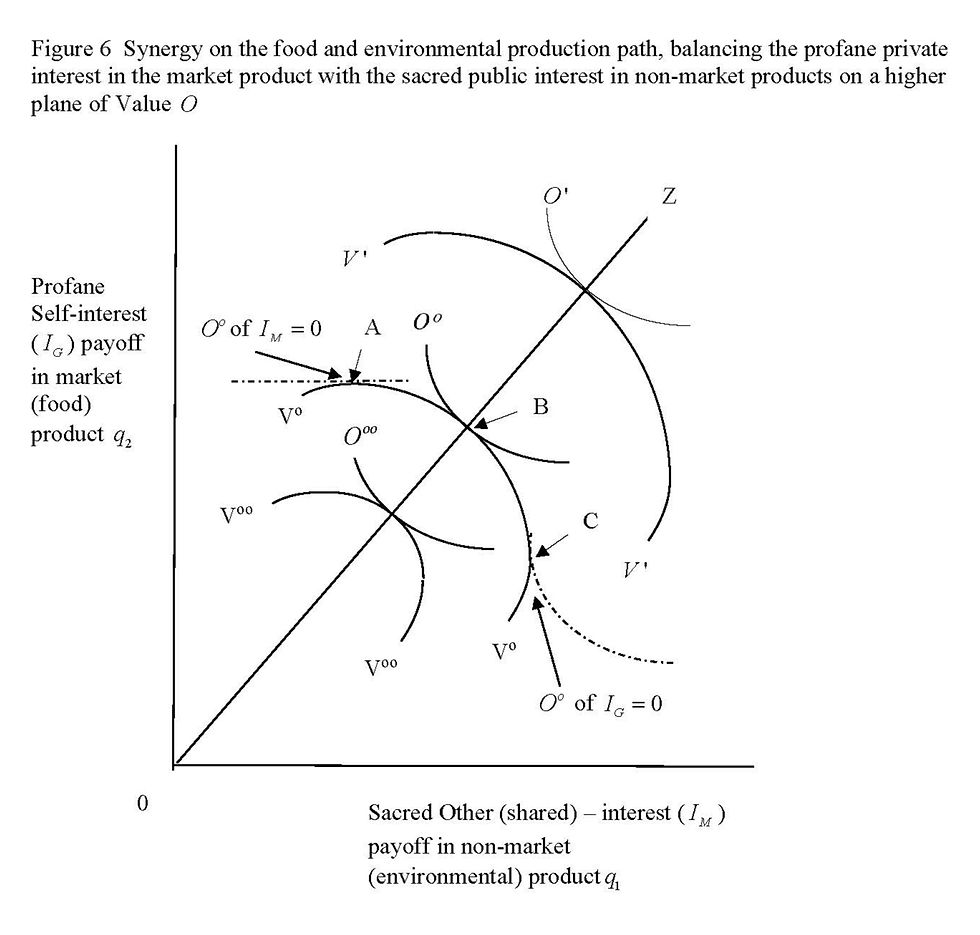
The DIT lens for making sense of water markets uses the following six images, figures reflecting the analytical system, in a forthcoming book which draws on the DIT and Metaeconomics framework in Lynne (2020), Lynne and Saarinen (2022) titled Water Economy: Balancing the Profane & Sacred. The Market Forum --- the water market, which works to find and represent the money valued, profane price P for water --- is represented in Figure 5. The Other Forum --- the community working to find and represent the non-money valued, sacred value O of water --- is represented in Figure 6. The two figures together represent how to resolve the old problem with balancing the profane & sacred, as in the price P for pushpins (water for economic profane purpose) & non-money value O for poetry (water for sacred community purpose).
The demand and supply of irrigation water is represented in Figures 1 and 2.


The profane dimension of water is represented in Figure 3, the standard diagram used by market advocates to explain the economic and social efficiency as somehow satisfied only in the profane use of water. Figure 4 is used to bring in the market skeptics view that the sacred also needs to be considered.


Dual Interest Theory (DIT) comes into play in Figure 5 to represent the Market Forum --- the profane water market. A truly functional water market, however, cannot be amoral as made clear by bringing Figure 6 representing the Other Forum --- some community: government entity --- that resolves the balance in the profane & sacred. The decision in the Other Forum on value O gives context to the price P that evolves in the Market Forum.

We now turn to making sense of Amoral Water Markets using the DIT analytical system represented in Figures 1-6. Keep in mind that water law reflects and gives content to the shared with the other-interest --- the reflection of what is sacred --- as represented in DIT on path 0M.
I. WATER RIGHTS AND WATER MARKETS
A. EVOLUTION OF WATER RIGHTS
1. Adoption and Transformation of Riparian Rights
Speaks to Riparian Water Law, with water law giving content to sacred path 0M, coming out of English Common Law… as in the natural flow doctrine, the reasonable use doctrine, and correlative rights .. and that water belongs to the public (public property, as in a common good served by that property), with only use rights assigned to individuals … and shortfalls shared across all users… ( p. 1347).
2. Creation and Spread of Appropriative Rights
“Traditional riparian use is limited to the riparian lands within the watershed of origin, with very limited storage or transportation rights. Private riparian rights are subject to “[a] continuing sovereign interest in the appropriate exercise of [the] riparian right…” particularly in navigable waters, including interests like fisheries or navigation… (p. 1348).”
.. stop and start to use again as the riparian user sees fit… not use it or lose it provision … “Legislatures and courts have stretched riparian rights to guarantee water for human needs in situations that would otherwise be incompatible with riparian rights, like water foveoff-stream industrial purposes or municipal needs.85 In many cases, riparianism “has evolved to allow consumptive use of water, the transference of water rights, and even transbasin water use in some cases (p. 1348).”
On the move to Regulated Riparian Rights Systems, mainly operating in the Eastern US:
“… eighteen of the thirty-one riparian states have continued this transformation by adopting a new water rights system: regulated riparianism. Regulated riparianism builds on the core ideas of riparianism but adds permitting requirements, time limits on rights, and increased regulatory oversight to harmonize riparian rights with modern water use priorities. This evolutionary history of riparian rights, from natural flow limits to regulated permits, is quite literally a textbook case of water rights evolving to serve human needs… (p. 1348).” Florida was one of the first, if not the first, to take the road to regulated riparianism. It has one of the most developed and sophisticated Other Forums in place.
Western US Prior Appropriation Systems give a substantively different frame on what is sacred on some path 0M…. as “… Joseph Dellapenna describes it, ‘The miners quickly sought to bring order to their lives through ‘vigilance committees,’ applying vigilante law based on the most elementary notion of justice: the first to grab it owns it … ‘Early state governments and courts across the West typically acquiesced or actively ratified these claims, adopting the now well-known ‘first in time, first in right’ western water law (p. 1349).” First in time, first in right in the domain of the profane took hold over what was a sacred right in water, often held by native, indigenous tribal nations in the Western US for centuries prior to the US being formed.
Quoting a Professor Johnson…. prior appropriation law:
“…reflects several fundamental principles: (1) maximum utilization of water resources, because water is necessary for settlement and progress; (2) prevention of speculation as a non-welfare producing, wasteful activity; (3) prevention of monopolistic control over water resources and protection of the small farmer; and (4) recognition that water is fundamentally public in character, belonging to the citizens of the state (p. 1349).” Well, the sacred is what is the public character.
Water could also be moved away from sources, as long as it led to beneficial use. Overall, public property was maintained in the water source, in the corpus of the water… and “…western states require that water rights be used or else lost, that water uses be in the public interest, and often that water use be reasonable … (p. .1350).”
Intriguing point made here: “From the modification and development of Americanized riparian rights and regulated riparianism, to the birth of appropriative rights and their gradual evolution, the history of the ever-changing American water right is a story of evolution in pursuit of better service to human values (p. 1350).” So, is this price P and/or value O?
Bork and Ziaja point to how it has been primarily price P as for economic development, but even the Western US prior appropriation states some concern for such things as instream use (primarily value O type use) has been assured… like adequate flows for fish passage as in California, Oregon and Washington…. even in the 1950s… and, then, “In the 1960s and 1970s, federal and state wild and scenic river acts and the burgeoning modern public trust doctrine directly protected instream uses in some states… (p. 1351).”
Domestic water use was always a part of it… with some states, in particular California, have even gone to codify that right in the water law, done in the year 2012, that “[E]very human being has the right to safe, clean, affordable, and accessible water adequate for human consumption, cooking, and sanitary purposes (p. 1351).”
“In spite of these official rules about water rights, in practice most of the nonde-velopment water values receive short shrift … (p. 1352).” DIT would characterized as short shrift in the domain of sacred non-money value O, while profane price P has dominated water allocation decisions, especially in the Western US.
The problem of not adequately reflecting value O in the Western US is quite visible, a case in point being California:
“… until the emergence of the modern environmental movement in the 1970s, California’s Water Board saw itself as purely ministerial, required to grant water rights with virtually no consideration on instream impacts or other public values … most state water right systems are an uncomfortable combination of three tranches of water rights: the first tranche is relatively undocumented rights that predate permitting requirements and were simply taken by users with no regulatory oversight whatsoever; the second is older permitted water rights that were granted with little oversight and sometimes in direct contravention of existing laws; and the third tranche is newer permitted rights constrained by environmental laws. Under the western seniority approach, the oldest tranche is paramount, taking its water before the newer rights… (p. 1352).” And, that older tranche was mainly if not exclusively about price P use, in effect claiming a profane use was somehow sacred.
3. Failures of Water Rights Systems
In California, it is mainly first tranche in place, along with riparian rights which never required a permit, with most of said water going to agricultural and urban uses. Arizona, almost all first tranche…. “… modern water systems primarily reflect the extractive, development-focused values of the late 1800s and early 1900s, frozen in time through the creation of durable private rights and ineffective efforts to protect public interests. Perhaps predictably, this has resulted in extensive negative impacts throughout the West… Skookumchuck and Kern River stories (in California) illustrate some of these negative impacts… (p. 1353).”
“(said) vignettes are emblematic of broader water problems in the western United States, where increasing conflict and decreasing (and decreasingly reliable) supplies are devastating both economies and ecosystems. The West is dry, with a regional average of 21 inches of precipitation per year, far below the eastern average of 46 inches and the national average of 37 inches… (p. 1354).”
“Roughly 12% of water withdrawn from water systems is dedicated to public water supplies (household, industrial, and other municipal uses); agriculture (mostly irrigation, with some livestock and aquaculture uses) accounts for 69% of withdrawals; thermoelectric power constitutes 15%; and other industrial uses comprise the remaining 4%. This excludes water left instream for ecological, recreational, ecosystem services, and other uses (p. 1354).”
“…flows in more than half of all rivers in the western U.S. are now depleted by more than 50%, and one-fourth have lost more than 75% of their original flows (p. 1355).” Clearly the sacred is under assault.
“… is already not enough water for all of the existing human uses to continue at their present rates while maintaining healthy ecosystems and increasing access to water; climate change will make the situation worse (p. 1356).” Again, the sacred is being overwhelmed by the profane.
“(most first tranche uses are in agriculture) the low-economic value rights should be constrained or forced to reallocate by the exercise of other public values in the water—through reasonable or beneficial use requirements or the public trust doctrine—but in practice these protections get short shrift (p. 1356).” Bork and Ziaja are suggesting the value O needs to override the low price P values… as in an Other Forum (value O) tempering what goes on in the Market Forum (price P).
4. A Brief History of Water Markets
“Scholars and managers typically agree that reallocation will be a key solution to the West’s scarcity problems. There is much less agreement about how this reallocation should happen—possibilities include regulation, narrow or basin- wide water right adjudications, condemnation, voluntary agreements, and markets. At least since the 1970s, the legal literature reveal a strong push for reallocation through water markets as a solution for western water scarcity issues, divided, as we outlined above, among evangelists and a more recent shift toward pragmatism (p. 1357).”
So, Bork and Ziaja attribute the evolution of water markets to the 1300s "enclosure movement" which started creating private property... with survey lines, fences, legal rules... “… the enclosure movement was about reducing common property to commodity status through enclosure, often trampling community rights and norms in the process (pp. 1357-1358).” The profane came into greater force with the enclosure of the sacred commons.
“Appropriative rights have always been about enclosure too, about walling off some chunk of the water in a stream for private use and sale as a commodity. More than riparian rights, which limited water use to the local watershed, appropriative rights treated water as a fungible good divorced from its social, physical, and ecological context. As in the enclosure movement, appropriative rights of-ten took public property with little or no attention to public use rights, public val-ues, and the laws established to protect them. Even so, some western states resisted complete commodification of water; historically ‘nine prior appropriation states prohibited or severely restricted an appropriator’s ability to sever appropriation rights from the land upon which the water was used.’ Even as these restrictions were loosened, protective measures like the no-harm rule served to restrict transfers.. (p. 1358).”
“(in) the late 1980s, all western states combined experienced fewer than 100 water transfers each year.” This began to change as part of the broader law and economics push in the 1970s and 1980s, and by the late 1980s many water experts and policy makers viewed ‘water as an economic commodity, to be priced, traded, and managed by the private sector’ (p. 1358).” The profane & sacred balance was shifting toward the profane.
“A study of water transfers in active regions across eight western states from 2002 to 2019 offers interesting data on transfers. More water was leased than purchased outright, by an order of magnitude, although more transactions were sales than leases. Transfers were concentrated across water volumes, with a large number of transactions for small quantities of water (0–20 AF) and for very large quantities (180 AF or more). By volume, California dominated (based on a small number of large volume transfers), and Texas had the highest number of transactions … (p. 1359).”
B. WHY WATER MARKETS?
Looking through the DIT lens, clearly Water Markets designed to pay attention to only path 0G are amoral. The focus must be on striking balance on path 0Z in order to achieve the moral (and ethical) water market. Said moral and ethical dimension is reflected on path 0M. Notice, too, how some sacrifice in the domain the profane, and some sacrifice in the domain of the sacred, are both essential to achieve economic and policy/social efficiency on path 0Z.
1. Economic and Policy Efficiency
Bork and Ziaja implicitly recognize that economists use cargo-cult science to make “efficiency” claims as though path 0G is the only economic and policy (socially) efficient path. In fact, as DIT makes clear, path 0M is the policy/socially efficient path. So, not. As DIT makes clear, the economically and socially (policy based) efficiency is achieved only on path 0Z.
And, this cargo-cult nonsense about path 0G:
“The Problem of Social Cost, theorized that, given sufficient property rights and no transaction costs, parties motivated by self-interest would bargain to arrive at ‘an efficient and invariant outcome regardless of the initial specification of rights.’ While the initial distribution does matter with respect to who profits and who pays in the transaction, Coase argued that the initial distribution would not drive the final allocation. In a water setting, for example, agricultural water right holders who use those rights to grow crops with very low profits would instead sell those rights to urban centers that would be willing to pay more …. (p. 136 1).” Well, there are always transaction costs, because there is always a shared other interest path 0M in the background of a Market Forum that needs to be accounted for in the calculations.
That is, said “Coase Theorem” is cargo-cult science on steroids, as TC > 0, always, reflected in building and acting out on path 0M assures it will not happen. Efficiency can only be achieved if the Other Forum(s) can represent the TC so as to achieve the efficient path 0Z. TC are both evolved within and represented by the Other Forum. So, TC directly affect the location of the best path 0Z within the attractor bounded by path 0G (economic efficiency) and path 0M (social/policy efficiency).
“…normative economic-efficiency approach underlies the market evangelist legal scholarship favoring western water markets; many market pragmatists also tend to emphasize this normative view, but with more nuance, recognizing that governments will have to ensure the protection of values that private decisions may under protect (p. 1362).” Normative economic efficiency sees only path 0G, the path of the market evangelist. Now, the non-market evangelist would see only path 0M. The market pragmatist would seek balance on some path 0Z.
“If markets maximize social welfare, the argument goes, then the best political choice is to get out of the way of markets (p. 1363)… ” Well, markets do not maximize social welfare because said markets in general ignore non-money value O --- ignore the poetry --- coming out of the Other Forum. The only way to maximize social welfare is to operate on path 0Z in the Market Forum, as influenced by the Other Forum.
2. (Re) Allocation
Reallocation from historically lower price P uses like agriculture to higher price P uses like industrial or urban water uses can be smoothly accomplished with a Market Forum. Problem is when the value O in the historical use is not represented, and, naturally, moving the historical used in an Other Forum without adequate regard for price P (like lost profit from irrigating crops, without compensation to the irrigator) will be resisted. As DIT makes clear, both price P & value O must play a role, as in both the Market & Other Forum must be engaged, in order to reallocate water from lower to higher valued uses.
3. Redistribution to Minimize Risk
Speaking here to junior appropriators being able to buy water use rights from senior appropriators, so as to reduce the risk.
4. Environmental Preservation
Argument here is that the people wanting to preserve such things as instream flows and ecosystem health can just go buy up the water use rights. As DIT makes clear, well, perhaps, but maybe people wanting such non-money value things simply do not have the wealth to so buy what is the realm of the sacred. The shift from the profane to the sacred could be extremely expensive, and people seeing the overall need to embrace the sacred may not have the money to do so.
5. Political Palatability
It is always easier to serve the profane than the sacred in a political process. So, sure, allowing sales from the profane to other areas of the profane, and even to the sacred if said people have the wealth to do so… sure, it is fully understandable.
“Market advocates argue that, compared with government regulation, “[w]ater markets provide a flexible, effective, and more equitable way of adapting to a dynamic world of changing human demands for water and uncertain supplies of it.” Because (quoting some libertarian economists) ‘the market is the premier allocator, and prices measure value,’ even “iff markets are not purely competitive, prices will generally be superior to other measures of value.” The idea of letting Adam Smith’s invisible hand guide water allocation can be appealing to politicians—willing buyers, willing sellers, and a hands-off government…. discussing proposals by California’s Senate to purchase, rather than regulate, existing water rights to provide stronger environmental protection. Why not let markets address western water woes? … Water markets will play a continuing role in water management… (p. 1366).”
Well, yes, the Market Forum can play some limited role, especially in the domain of the profane. And, it works as long as the Other Forum helps bring the sacred into play. Keep in mind the goal is some path 0Z within the attractor bounded by profane economic efficiency on path 0G and sacred social efficiency on path 0M. It is about striking balance in the profane & sacred on path 0Z, striking balance in the Market & Other, Market & Community: Government, the latter inclusive of all the people in the community of shared interest.
II. WHY NOT WATER MARKETS?
Water markets are embedded in a political economy and physical geography that makes pure water markets impossible and at least some level of market failure inevitable … (pp. 1366-1367).” Yes, the political economy part is represented in the Other Forum, broadly outlined by the US Constitution, as in a Constitutional Republic. The physical geography part reflects the reality of the Spaceship Earth hydrologic and geographic (rivers, lakes, aquifers) system working in the background of that Market Forum.
Also, on political economy, pointing to the Western States: “… initial allocations drive market outcomes, we continue by identifying ways historic water right allocations reflect systemic exclusion of many minority groups and argue that water markets and socioeconomic barriers to water-market participation perpetuate this injustice… (p. 1367).”
Also, the common good, public good side, the public trust --- the sacred side --- is often discounted.. “… both evangelists and too many pragmatists seek to firm up water rights by stripping away public restraints rather than applying existing law to uncover a smaller but firmer water right (p. 1367).” It is to strip away the common good to serve only the individual good, when both must be served at the same time as in individual & common good on path 0Z. The public, Other Forum must be reinvigorated to give context to the Market Forum.
A. MARKETS ARE NOT VALUE-NEUTRAL TOOLS THAT IMPROVE WATER MANAGEMENT
Bork and Ziaja (2023) draw on Institutional Economics, as does Metaeconomics, to address the value question. Markets are not value neutral as market advocates claim without empirical evidence, so it is at least an open question that water markets improve water management.
1. Economic Efficiency of Water Use May Not Maximize Social Welfare
DIT makes clear a Market Forum not given context by the Other Forum does not achieve economic and policy efficiency, as the focus is only on the profane, economics-only path 0G. And, this is about more than just the distribution of wealth, making some more able to express their values. It has to do with the expression of non-money value, the sacred, and not just the money value in the profane.
Speaking to just wealth distribution alone, this “…means that unadorned market approaches will not actually maximize social welfare… and produce unjust outcomes (p. 1369).” Yes, it does produce injustice, but also it does not address the matter of what is sacred: “…aggregated individual exchange decisions ignore key water values. In a market approach, ‘all non-market values are subordinated to those the market recognizes.’ The market will not adequately protect values that are not readily commensurable or that cannot accurately be captured in terms of exchange value (p. 1369).” Absolutely. It is the profane pushpins and sacred poetry problem.
“ (water).. has multiple values to communities that may not be expressed through individual decisions (p. 1369).” Ecosystem services are a case in point. Yes. Water has jointly represented individual & common good value.
“… aggregated consumer willingness to pay is also unlikely to adequately address broader ethical concerns (to) include … distributional concerns such as assuring an adequate supply of water for all people… (p. 1370).” Yes: The Ethic is generally underrepresented in the reaction only to Incentive.
“… value in water policy that expresses ‘a formal acknowledgment by the state government that it considers its waters to be more than mere spoils to be divided up among private parties…’ (p. 1370).” The state must also represent the common good, not just the individual good.
“…water governance that focuses solely or primarily on the economic efficiency of water markets assumes a particular moral view of the world; it is not an amoral, value- neutral water policy (p. 1371).” Absolutely. The shared other-interest is always in play, in this case an ethic held among the individual good only traders that ruthless trading is the way to run any kind of allocation and reallocation problem: Only price P matters, in response to Incentive, and the Ethic as Other People outside the trade would see it is of no accord. It is a kind of Dark Empathy only in play among the ruthless traders.
Water Markets Do Not Determine Values; They Express Them
“Market advocates, particularly in the political arena, paint markets as an alternative to government interference. Remember, ‘markets are smart, government is dumb’… Well, DIT makes clear Markets are also dumb at expression value O, while admittedly the Market is smarter at evolving and expressing price P, not so much value O.
Markets determine price P, but said price P in the domain of the profane must reflect the background value O of the sacred as addressed in the Other Forum.
“… contrary to the custom of economists to paint a dichotomy of ‘free market or state intervention,’ markets ‘take place under a continuously evolving institutional structure which we call rules, legislation, agreements and collective regulations which establish acceptable norms of individual and group behaviour’ (p. 1371).” Absolutely, as DIT makes clear… the rules, legislation, agreements and collective regulation all come out of the Other Forum(s), and give context to the Market Forum.
“… functional water markets require ‘at least three institutional choices: a cap [on how much water is available], an initial allocation of property rights, and trading rules (p. 1371).” Notes how caps are often absent in the Western US. “… first two tranches of water rights were established without consideration of limits of water withdrawals, under a priority system that rewarded those who sought water rights for every drop of water in the system (p. 1371).”
“… consider the initial allocation of water rights, which sets the stage for the market. As this history explains, most rights were obtained either by purchasing riparian lands or by diverting water and putting it to productive use. This history creates serious fairness and justice concerns about the distribution of water rights, explained more fully below. But the requirements also meant that water law “was written for diverters” and thus “ignored instream uses such as fish and wild-life habitat and hydropower.” The values-based institutional choices about who could obtain a right to western water, often made over a hundred years ago, favored diversion and use over instream flow and favored agricultural interests over inchoate urban uses. In many cases, instream uses like fish protection or re-creation were not even considered beneficial uses of water until the mid-twentieth century. Water left instream was often considered available for other users (p. 1373).”
“ (on trading rules) jurisdictions in the West, for example, impose a no-injury rule on transfers, which lets other water users or the state stop a water transfer if the transfer would hurt their interests or the public’s interest in the source watershed. Trading rules are particularly important because they are sometimes offered up as a way to fix the cap issue; many states make trades subject to a public-interest test or other requirements that might keep some of the traded water instream. But only four states (California, Wyoming, New Mexico, and Utah) consider impacts beyond effects on other water right holders when reviewing water transfers.291 Analysis of permitting for ground-water transfers suggests that, in practice, most transfer rules focus on impacts to other water right holders. Robust transfer rules are often identified as a signifi-cant impediment to more active water markets in the West (p. 1374)”
Yes, as DIT makes clear, an Other Forum is essential: “Say a community, or even a state, needed to decide whether it was preferable for water to remain in a particular river to support life, or if it were preferable for water to be withdrawn and used for agriculture. A water market for water rights on that river cannot make these decisions for the community (p. 1374).”
“Yet other economists who favor deep consideration of law and social context—“old” institutional economics—add that although markets do not explain institutional change, neither does efficiency, because existing and legacy institutions heavily influence the weight of the economic values in the efficiency calculus. … Therefore, what markets do shift—for example, from apparently lower- to higher-economic-value uses for water—is “an artifact of prevailing property arrangements, technical conditions, and the wealth position of buyers and sellers (p. .1375).”
“Can, then, markets improve economic efficiency through atomistic choices and redistribution? Institutional economics answers yes but only within the boundaries of the existing institutional context—institutions determine a great deal about the efficiency markets produce. And institutional boundaries determine which groups and individuals can participate and who benefits. Water markets do not determine values, they just express them (p. 1375).” Yes, as DIT makes clear, the Other Forum producing value O gives context to the Market Forum giving price P, so while water markets may express price P, that price P is a reflection of the non-money value O coming out of the Other Forum.
Market Failure Is Inevitable in Water Markets
Yes, in that Markets cannot adequately represent the value O in the domain of the sacred. The only way the Market Forum can avoid failing (which is at any point on path 0G), it must consider the influence of the Other Forum in the domain of the sacred, and work to operate on path 0Z.
It is not only the social value O problem, but also the physical geography of water that creates failure in the Water Forum. “Marie Livingston lays out the physical and social characteristics of water that make market failure ‘endemic’ to water markets: ‘water is fugitive, lumpy and rife with externalities. Moreover, water use is often nonrival, entails substantial transactions costs and suffers from information deficiencies.’ In other words, geography prevents water from behaving like a ‘normal’ commodity. That sets up a ‘market’ in which negative externalities are inevitable, necessarily troubling markets (p. 1376).” Well, as DIT clarifies, there is no such thing as an externality, as everything is embedded within the Spaceship Earth system. The problem is that the shared with the other-interest is being ignored when one uses a SIT view of the Spaceship system. Nothing is external in the reality described and represented by DIT.
B. MARKETS IMPEDE MODERN PRINCIPLES OF EQUITY AND FAIRNESS
1. Unjust Historic Water Right Allocations Thwart Equity and Fairness in Water Markets
“…markets impede fairness and equity because they are reflections of the historic injustices in the initial formation and distribution of water rights (p. 1378).” DIT points to the need to strive for more a more optimal inequality, and to avoid the plague of extreme inequality which assures economic and policy efficiency cannot be achieved.
“… little wonder that core doctrines of riparian rights and prior appropriation were developed alongside the rise of agricultural industrialists and large land- owning firms—leaving out the poorer classes and non-‘white’ ethnicities … (p. 1379).”
And on “white” rights” … “In sum, water rights were simply harder to obtain for nonwhites, and this inequity forms an unjust basis for modern water allocation. Water markets built on these allocations will perpetuate these inequities and frustrate other attempts to reallocate water rights (p. 1382).”
“As legal historian Catherine Miller painstakingly demonstrates, one of the largest business corporations of the late-nineteenth-century, West, Miller & Lux, shaped water law in California, Oregon, and Nevada to ensure their cattle empire had access to water. Co-owner Henry Miller bought up land with direct access to water and then used the courts to ensure that California adopted the riparian doctrine to prevent competitors from appropriating and diverting water from his lands. When the courts became less reliable, Miller & Lux lobbied the California legislature, and later the Water Commission, for changes to water law that would benefit his holdings. As Miller & Lux’s wealth decreased, so did its influence, but the contours of California water law still reflect its formative role. (p. 1382).” Clearly Miller & Lux were heavily influencing what was in the shared other-interest, tilting it toward the profane individual good, the profane self-interest of Miller & Lux without regard for the sacred common good.
“Initial rights have been stubbornly persistent… (p. 1382).” To be expected, as profane self-interest resists any shift to a more reasoned balance in the profane self-interest & sacred other (shared)-interest.
“In 1966, a little more than one hundred years after the Treaty of Olympia created the Quinault Indian Reservation on Washington’s Pacific Coast, while the State of Washington gave away water on the Skookumchuck to new coal power plants, the Quinault Tribe sued the state to enforce its territorial sovereignty within its reservation. The Quinault Reservation is rare among reservations in the United States in that it contains ancestral lands of the Quinault.,,, The culture, health, and beliefs of the Quinault Indian Nation are deeply intertwined with the health of salmon populations, and so the continued survival of the Quinault as a cohesive people is dependent on sufficient instream flows to maintain the salmon. (p. 1384).” The Quinault sacred interest was taken over by the profane interest of the power plant developers.
2. Markets Frustrate Meaningful Participation in Water Governance
“First, who can and should participate in decisions becomes weighted in favor of market participants. This empowers a constrained set of sellers and buyers to make decisions about water rather than the whole population of a community, river basin, or state. Moreover, as noted, the pool of market participants is often not representative of the broader community. Second, when in place, markets can subsume glaring inequities that may have otherwise prompted deliberation and collective action, discouraging nonmarket participants from engaging in collective decision making (p. 1385).” A viable Other Forum must be in place to ensure the nomarket value O can be evolved and brought into influence the profane expression of price P.
“Water markets can seem to “work” while hiding important matters of fairness, which may ultimately undermine the existence of the market.383 The ability of markets to mask conflicts over competing values with a veneer of efficiency can delay and prevent public input and debate…” (p. 1386). Markets can easily lead to the plague of extreme inequality, working to mask the need to see a more optimal inequality.
Case of the “… Environmental Water Account program. The joint federal and state Environmental Water Account program and the United States Bureau of Reclamation’s Water Acquisition Program in the 1990s and early 2000s both created mechanisms for government entities to purchase water from private contractors to make sure there was water for instream environmental uses… The Environmental Water Account was created to help preserve endangered species, which depend on water in the Sacramento-San Joaquin Delta, while reducing conflicts with other water users. To accomplish this, the Water Account used up to $50 million per year from bond proceeds to purchase water from willing private water contractors, who had paid for water from the Central Valley Project and State Water Project. That program provided 380,000 acre-feet of water annually for instream uses and was somewhat successful in preserving water for species protection. But the market mechanism also exacerbated social concerns—unfair enrichment of the already quite rich. It was functionally terminated by the legislature after an investigation found that the program was being gamed by a single individual and the Kern County Water Agency… ‘Roughly one-fifth of all the money spent to buy water for the program went to companies owned or controlled by [Stewart] Resnick, one of the state’s largest farmers. ,,, While it existed, the California legislature did not act to add protections for species. The market’s existence seems to have pacified lawmakers… ( p. 1387).” Clearly, the profane worked to dominate the sacred.
C. MARKETS HINDER WATER GOVERNANCE
“…. Part II thus far, we have explained (1) why water markets are not amoral machines but rather reflect the value judgment inherent in the institutions that create them and (2) the ways that using water markets without the hard work of modernizing water governance can perpetuate inequity. In this final Section, we explain how water markets can harden private water control and water use in ways that lock in the negative impacts we have discussed by driving statutory, judicial, and other changes to water law (p. 1388).”
Yet, the sacred has always been important: “The history of water use is marked by ‘astonishingly universal regard for communal values,’ even in the western water context, but western water law also has a strong bent toward treatment of water as an enclosable commodity (p. 1388).” The western bent has been to the profane, not paying much attention to the sacred.
“… a deep tension within water rights between water as a commons, vital to life, and water as a commodity (p. 1388).” Again, the tension is between the sacred (vital to life) and profane (water as something to be used for economic purpose).
“… most market advocates push to reduce uncertainty by reducing public limits on water rights rather than by enforcing these limits and allowing markets for what remains .. (p. 1389).” The sacred can be handled with sacred caps on how much water is subjected to trading in the profane market.
“As Bromley puts it, “This is not merely a clash of worldviews. It is a clash of contending truth claims about how to figure out what is to be done in the public sphere—it is confrontation between prescriptive consequentialism and reasoned public debate over how to get to the future.” The reasoned public debate has to be ongoing in the Other Forum(s).
“In the next two subsections, we show (both theoretically and in practice) how markets decrease other elements of water governance—public oversight, enforce-ment of existing law, protection of nonmarket interests, hardening of rights, etc.— and can make scarcity worse. We conclude this Section by showing that reliance on water markets makes these changes enduring, frustrating future attempts at more robust water governance… (p. 1389).” The sacred is easily overridden the profane, as the latter is more primal.
“Good water governance also requires practice and iteration of collective-choice arrangements and visibility of interests. Markets can shut down those conversations and obscure interests, halting the evolution and adaptation of water governance to new physical conditions (cli-mate change) and values (social equity) (p. 1390).” Yes. Talk, talk, talk that must go on to establish the sacred in the Other Forum gets stopped with the focus on the profane in Water Markets.
1. Markets Decrease Governance of Water Rights and Can Exacerbate Scarcity
“The link between property rights and markets is key to understanding how reli-ance on markets erodes other forms of water governance. Much of the literature advancing water markets focuses on the ways water rights should change to maxi-mize market efficiency; the traditional law and economics approach, following Coase and Demsetz, prescribes “property rules [that] define rights such that transfers to the highest valued use are made easier (cheaper).”That means protecting possession of private water rights and limiting restraints on transfers. Protections for third parties and for the public’s interests are seen as impeding water markets by casting doubt on the security of the water right, increasing transaction costs, and making market transfers more difficult and thus less appealing… (p. 1390).” It is in the shared other-interest, in the domain of the sacred, to protect people outside the immediate trade.
“… markets often lead to hardening of water rights through statutory, judicial, and other changes to water law (p. 1390).” The profane gets the emphasis, as the sacred gets set aside.
“First, many rights do not comply with existing law (for example, the first and second tranches of water rights), and these rights face significant uncertainty because the state could choose to enforce that existing law. Second, even for rights that are well regulated, the amount of the right can change based on new information, changed physical circumstances, and changes in state priorities (p. 1391).”
On the second: “… well-regulated rights that are inherently uncertain, consider the beneficial use requirement, with its reasonable use compo-nent. Water rights are limited to beneficial use, and, as the Ninth Circuit has noted, ‘…it is settled that beneficial use expresses a dynamic concept, which is a ‘variable according to conditions,’ and therefore over time’ (p. 1391).” Also, what may be reasonable during a time of abundant water in the source may not be reasonable during a drought. The content of the shared with the other-interest varies as does the rainfall upstream.
“Markets can and do function despite such inherent property right uncertainties, but the general push by market advocates to decrease this inherent flexibility in water rights threatens to decrease the state’s ability to govern water. These tensions have led some commentators to conclude that ‘.. markets as a system are inherently antithetical to the state’s mandatory fiduciary responsibility,’ or that markets inherently reduce the state’s role in enforcing “the waste and reasonable use doctrine, the public trust doctrine, and various environmental protection laws.” If markets are to perform the functions that their advocates suggest, the markets should have to contend with the inherently unsettled nature of even well- regulated water rights rather than change the law to eliminate the uncertainties (p. 1392).” An Other Forum is needed to regulate water rights.
“… other category of uncertainty in water rights stems from the unregulated nature of most first- and second-tranche water rights. Because these rights have never been evaluated under public trust, environmental law, or most other public- interest tests, these rights remain subject to a great deal of regulatory uncertainty, no matter how well established their holder may think them. Some market advo-cates argue that the past failure of most states to provide meaningful enforcement of existing waste and unreasonable use laws or other laws protecting the public interest means that markets are a better way to achieve the same result … But this presupposes that the private preferences expressed through markets actually align with the public interest and cannot be inherently wasteful; this is wrong… (p. 1392).” Yes, wrong indeed, as value O is also changing as in the public interest evolves as well as does the private interest reflected in price P.
On more reasoned Water Markets: “For example, Garrick and his colleagues focused on the necessary preconditions for water markets in overallocated regions seeking to protect environmental flows, emphasizing the need for tradable rights coupled with “(1) establishment of rights to and limits on freshwater extraction and alteration; (2) recognition of the environment as a legiti-mate water use; and (3) authority to transfer existing water rights to an environ-mental purpose.” But the key element is that “institutions and sound governance come before the market (p. 1393).” Yes, absolutely… the Other Forum .. institutions and sound governance must operate in concordance with the Market, as in Market & Other Forum.
Amazing influence from the free market environmentalism “cult”: “… the late-1970s, as California was emerging from what was then the state’s worst drought432 and free-market environmentalism was on the as-cendancy, the Rand Corporation and the 1978 Governor’s Commission to Review California Water Rights Law both released reports calling for a greater role for water markets and recommending a variety of changes to water rights to enable them.433 These changes included “protection of conserved water from for-feiture, authorization of transfers of conserved and surplus water, and a declara-tion that the willingness of a user to transfer water may not be used as evidence of prior waste or unreasonable use.”434 Within a decade, the California legislature embraced this approach, declaring that the public interest requires state agencies to assist in the deployment of a water-market approach and changing a host of laws to encourage marketing… (p. 1394).”
“Even more surprising, California law provides special treatment for the marketing of pre-1914 appropriative rights, that oldest tranche of water rights that has never been reviewed under modern environmental law. Transfer of pre- 1914 rights does not require review or approval by any state agency; third- party impacts are addressed by lawsuits after the fact, and none of California’s statutory protections for fish, wildlife, other instream uses, or the broader public interest apply. Due to this exemption and an exemption for transfers that do not require “a change in the point of diversion, place of use, or purpose of use as set forth in a permit or license to appropriate water[,] ...the lion’s share of water transfers that have occurred in California over the past two decades have been undertaken without the [Water Board’s] review or approval… (p. 1395).”
“California is not alone in changing its laws in this way. Utah’s 2020 Water Banking Act provides that water rights deposited in the ‘bank are exempt from beneficial use requirements and protected from forfeiture.” … Oregon seeks to “ encourage the highest and best use of water by allowing the sale or lease of the right to the use of conserved water.” Washington, Wyoming, Arizona, and Idaho all offer similar protections. A Model Water Transfer Act for California, proposed by the California Business Roundtable, the California Chamber of Commerce, the California Farm Bureau Federation, and the California Manufacturers Association, would have gone even further, but it does not seem to have gotten much traction thus far. There are other concerns about the power of water markets to frustrate regulation, and these concrete examples show that this is not merely a theoretical concern but rather an ongoing result of the push to alter water rights to encourage markets (p. 1396).” It seems some Other Forums are in play in the West, but not as widespread as perhaps needed.
“…the market transfer frustrates governance. Had the state decided to adjudicate the basin or otherwise reign in inefficient uses before the transfer, the state could have mandated more efficient water use across the basin and then used some or all of the “new” water to protect the instream values long ignored in the basin. Or a private lawsuit could have forced the state to reign in water rights that violated the public trust doctrine. But after the transfer, the private party has already eliminated the inefficiency and sold the water, hardening the water right…(p. 1397).”
“As this Section shows, the pressure from markets and market advocates changes the nature of water rights through statutes and other means, threatening a state’s ability to achieve changing policy goals by altering the way water is used (p. 1397).” Yes, the profane Market frustrates the sacred shared other-interest in the Other Forum.
These Changes Are Durable and Frustrate Future Governance Efforts
As DIT clarifies, once something has been taken out of domain of the sacred, it is difficult to every put it back. Governance in the Other Forum, once lost, it is relegated to the ruthless exchanges of the profane Market Forum, and the sacred is never engaged again.
“Professor Erin Ryan discusses the chilling effect of creating potential takings claims in natural resource commons as a tool to frustrate future governance efforts. Ryan defines the ‘takingsification’ of environmental law as
‘the strategic deployment of private rights in public commons during periods of environmental deregulation [that] can be used as a foil against later environ-mental conservation–a tool for “salting the land” against new or resumed legal protections in the future–by creating a variety of legal hurdles, including the threat of takings litigation.’
Thus, ‘property rights become a tool for entrenching environmental deregulation and undermining public rights in critical natural resource commons’… (p. 1397).”
“Though the government could avoid these concerns by participating in the market and buying desired rights directly, this shifts protection of the public commons from a public responsibility within the state’s police power to a public choice subject to fiscal scarcity and other limits. Such a change is likely to result in less protection and seems an abdication of the public trust responsibility (p. 1398).” Yes, removing it from the domain of the sacred to the profane… well, then, one must act out in the currency of the profane as in paying price P in order to return it to the domain of the sacred with value O.
“As Professor Carol Rose notes, “people with relatively narrow but intense interests can capture the political process from those with wide but diffuse interests. When they do so, they can pull up the gangplank behind themselves, ...while making the lives of competitors and consumers more costly and difficult… (pp. 1398-1399).”
“As Professor Doremus argues, commodifying the commons deprives the public of its commons to the benefit of “focused interests” who capture resources. Undoing this change imposes economic losses on those focused interests: “Those losers, as current property owners, are not likely to be the relatively powerless whose claims can be ignored ...[and] imposing concentrated losses on the rich is likely to prove impossible. Once they emerge, therefore, property rights are expected to be sticky.” Changes that impose concentrated costs on powerful groups in exchange for diffuse benefits for the public are notoriously difficult to accomplish (p. 1399).”
“While some have suggested that doctrines like the public trust serve as ‘an institutional side constraint on water management by ensuring that the government can always reconfigure water rights and policy in the interest of the general public—no matter what private rights it has awarded,” this analysis suggests that reconfiguring marketed water rights will be extremely challenging. In practice, commodification seems like a one-way ratchet. As Professor Huber argues, this durability phenomenon suggests ‘policymakers would, at times, do better to design around this pathology than to attempt to cure it—for example, by thinking twice before creating new forms or categories of private claims to public resources…’ (p. 1399).”
III. CONCLUSION: LOOKING FORWARD
“We began with a utilitarian view of the history of water rights, which showed that water rights developed to serve a wide variety of social values but that many of those values had been subsumed by the mid- nineteenth century demand for economic growth. As a result, our current water rights system is failing to meet the needs of modern society. We continued with an overview of the push for water markets that emerged as part of the broader law and economic push in the 1970s and 1980s and then discussed the benefits of market approaches to water reallocation (p. 1400).”
“… three core critiques of water markets under existing western water law. First, we used an institutional economics analysis to show that markets are embedded in a political economy and physical geography that makes market failure inherent in water markets. Second, relying on our historical analysis and the institutional economics insights, we identified some of the failures in fairness and justice that underpin our current water rights system and showed that a mar-ket approach can perpetuate these problems. Third and finally, we explored the ways that markets can change water rights and frustrate future efforts at more robust water governance (p. 1400).”
The Western US is weak in Other Forum(s): “… the public governance leg of that tripod is the weak link in western water law, and proceeding with markets in that context both makes markets less likely to succeed and makes future governance improvements much more difficult (p. 1400).”
“Professor Barton Thompson notes, ‘Markets, without governmental intervention, will generally not protect the poor, promote the environment, or advance other purely public interests in water resources. The commodification of water can thus lead to greater water in-equality and to environmental degradation if adequate governmental institutions do not exist to protect these other interests’ (p. 1400-1401).” Yes, the Other Forum must give context to the Market Forum, as in Market & Other, Market & Community: Government, the latter an inclusive of All the People Government.
“…Article has shown, however, western water law currently lacks the institutional foundations and governance capacity necessary for water markets that will help rather than hurt.480 Thus, the first step toward markets that could actually accomplish what their advocates suggest is improved governance. Similarly, market skeptics tend to argue for reinvigorated public water governance, often based on some combination of reasonable use, public trust, revitalization of existing instream flow laws, and meaningful enforcement of existing law. Market skeptics see this as an end goal rather than as a step toward broader deployment of water markets, but the question of the ultimate destination should not get in the way of efforts to achieve better water governance right now (p. 1401).” Other Forums must be better developed.
First, better governance means addressing the inequities in water rights that result from historic discrimination… Second, improving water governance requires robust instream flow protections… Finally, as water governance adapts to provide robust protection for instream flows and address existing inequities, successful efforts to improve governance must apply to historic water rights, not just new water rights. The first and second tranches of water rights faced little to no regulatory scrutiny and have typically never been assessed against modern environmental law or other priorities for water use. For example, these old rights have frequently evaded review under state public-interest standards, reasonableness requirements, public trust, or other laws that balance private rights against public needs. Regulating new rights alone will do little to address scarcity issues in the West; most surface waters in the West have been fully appropriated since at least the 1970s .... In California, for example, the state has issued appropriative rights to more water than is avail-able, and riparian and first-tranche rights claim far more water; the total water claimed is unknown. .. Regulating the third tranche of water rights is also insufficient (p. 1401).”
“Water markets are not amoral machines that use private willingness to pay to determine the welfare-maximizing distribution of water rights. Instead, water-market outcomes reflect the contested history of water rights, dominated in large part by demand for economic growth and a preference for white ownership. Water-market outcomes also reflect market failures due to the physical geography of water and the political economy of water management. Embracing markets now, without reform of water governance, will harden these past mistakes and frustrate efforts to correct them in the future. Water markets in the West will not be successful unless they are predicated on better nonmarket water governance (p. 1405).”
Absolutely. As DIT makes clear, better Other Forum governance is essential to represent the sacred and to give context to the profane represented in the Water Forum. The Western States might consider something akin to the Florida Water Management District. Said districts are defined on hydrologic boundaries, and are funded by local property taxes. Said funding makes possible the staffing of the districts with highly competent staff; one of the Districts actually is involved in partnership with a Florida University to award a PhD in water management. The Florida Water Management District is also built in accord with the Regulated Riparian Water Code to revise Riparian Law, focused mainly on the Eastern US. The Western US needs a similar revision, as in a new Regulated Appropriation Water Code, focused on fixing the water governance problem in the Western States.
References
Bork, Karrigan and Ziaja, Sonya. "Amoral Water Markets?" Georgetown Law Journal 111 (2023): 1335-1405.
Lynne, Gary D. Metaeconomics: Tempering Excessive Greed. Palgrave Advances in Behavioral Economics, John Tomer, ed. New York: Palgrave Macmillan, 2020 ( https://tinyurl.com/yxagxtuf )
Lynne, Gary D. and Saarinen, Phyllis P. “Metaeconomic Solutions to Dysfunctional Water Markets.” In Altman, Morris (Ed.) Constructing a More Scientific Economics: John Tomer’s Pluralistic and Humanistic Economics. Palgrave Advances in Behavioral Economics. New York: Palgrave Macmillan, Chapter 15, 2022, pp. 309-329.


Comments